Giving the Dead their Due: Reactions to Death in King Lear

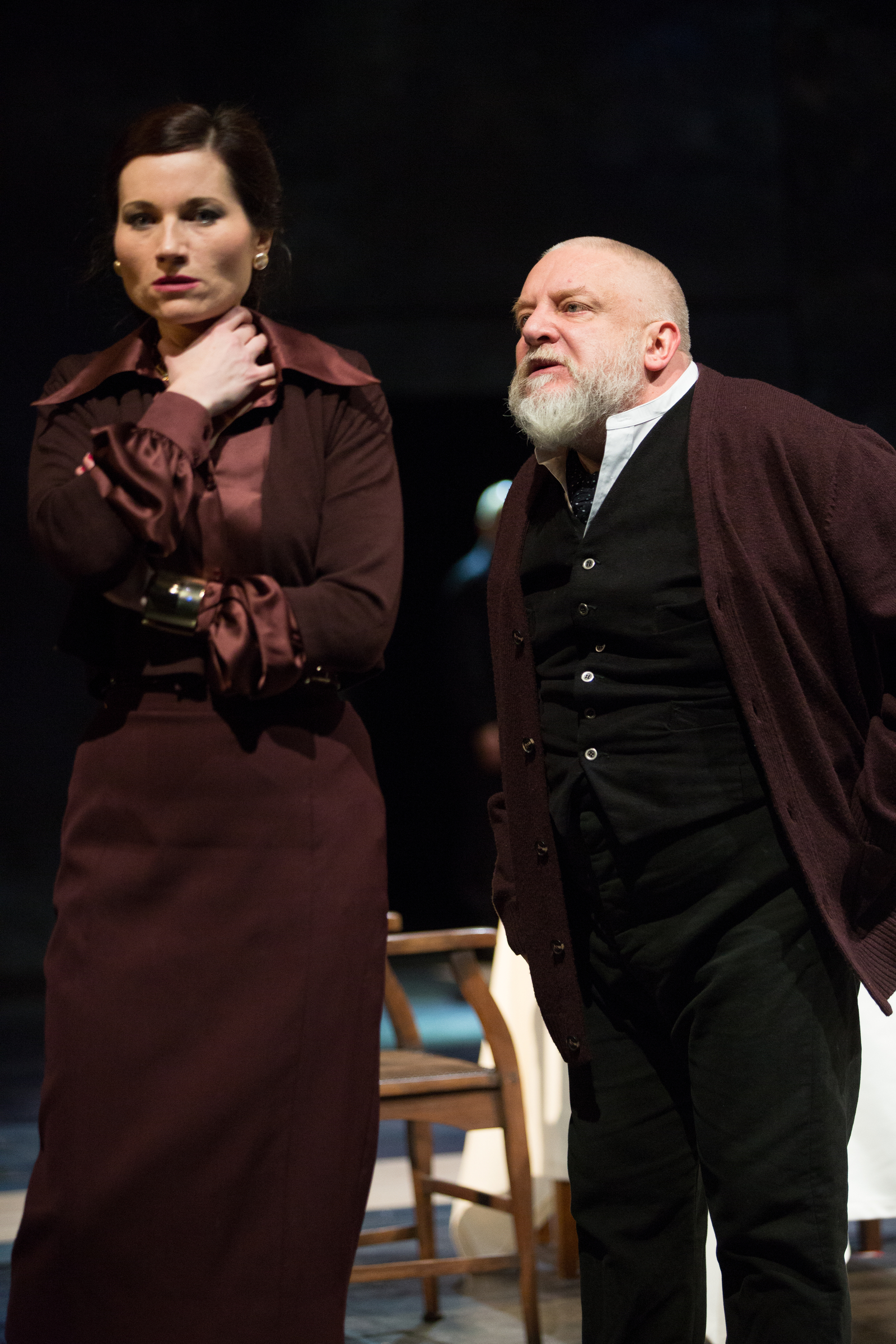
Sam Mendes’s long running production of King Lear does not shy away from showing the grisly realities of being a character in a Shakespearean tragedy. While ultimately faithful to the original dialogue that Shakespeare wrote, the production takes it’s liberties with where and how and sometimes even ifs of its characters shuffling off of the mortal coil. By showing the audience all of the deaths that comprise the play’s final body count, the director allows for what would normally be an opportunity to further explore how various characters surrounding the newly deceased would react to the death. In Mendes’s production, however, responses from any of the characters to any of the carnage unfolding around them are a complete rarity. By having the characters essentially ignore the multiple murders and death around them, the director creates the impression that the characters are desperate to pretend that everything is fine, which not only makes the moment when a character finally reacts fully to the death of another character all the more powerful in showing just how tragic events have become, but serves to demonstrate ‘not okay’ events will continue to be for some time after the play’s final scene.

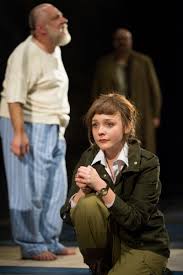
An early (and unexpected) death is that of Lear’s fool, who is beaten to death in this production instead of merely disappearing. While the king is manic and angry during the actual beating, he seems to forget the entire incident as soon as he drops the metal pipe. Lear barely even gives a sideways glance to where the fool lay when the man revives long enough to gasp out his final line. Edgar and Kent are also present for the entire scene, but do not react to the events unfolding around them. Instead, both men sit and watch their king murder the fool with little emotion. Later, when Gloucester enters the scene and sees the body of the fool in front of him, he gives no more response to the sight than someone else might give to finding a dead bug in their path: mild revulsion, but very far from upset. The lack of response to the death of the fool is understandable in the immediate context of the play. All of the men who see the murder or the body of the fool are either exiled or wanted dead at this point in the play. By refusing to act even mildly upset at the fool’s murder, the characters allow themselves the opportunity to deny exactly how grim their situation has become and keep the hope that things will soon return to the previous, more stable state alive.

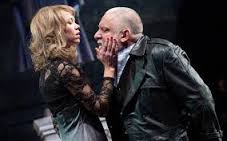
Another early major character death we see in the play is that of Cornwall. While the audience can clearly tell that Regan is upset in this scene, Regan is only reacting to her husband’s injury in this scene. Cornwall does not actually die on stage, however. Instead, the next time we see Regan, she is at what is clearly her husband’s funeral. While this would be the moment in the production to show what Regan’s reaction to Cornwall’s death, the mourning black is all that audience gets. In the scene, Regan simply snaps her umbrella shut and conducts her business as if nothing particularly noteworthy has occurred. It is clear from Regan’s reaction that she wishes to put the entire instance behind her. Another interesting thing to note in this pair of scenes is the murder of the servant who killed Cornwall. Immediately following his stabbing of Cornwall, the servant is killed by an enraged Regan. Besides Regan, Cornwall, the servant and the now-blind Gloucester, however, another pair of servants is present in this staging of the play. These servants do nothing to stop either the servant who stabs Cornwall or Regan; instead, the two other servants spend the almost entire scene staring straight ahead, not even flinching at either murder they witness. These servants serve as a parallel to how the more important, named characters view the events: as something to ignore in hopes of things returning to a more normalized state sooner.

The lack of reactions the characters have to other characters’ deaths is most apparent in the final scene of the play, when the body county quickly multiplies. As Gloucester and Edmund die, Regan is murdered, and Goneril commits suicide, the fact that none of the other characters seem to have any greater response to the deaths beyond a basic acknowledgment becomes more and more unnerving. This uneasiness the audience feels with the surviving characters seeming indifference serves to not only increase the tension in this scene, but show just how delusional the surviving characters are becoming in their continued idea that events can still turn out in their favor and that a neutral status quo can be achieved again. This desperate hope is finally dashed when Lear reenters the scene with a dead Cordelia. This moment in the scene is the first where the audience is allowed to see a character truly react to another’s death and give a proper response (in this case, mourn). While the reaction is limited to Lear, the moment serves to drive home the tragedy of the play. When this is paired with the surviving characters lack of reaction at Lear’s death only moments later, the scene suggests that all of the remaining characters have given up on the idea that things will ever return to their previous quasi-happy state and that the constant and senseless death has become the new normal, giving a chilling context to Edgar’s closing lines for the play.

The characters in Sam Mendes’s production of King Lear spend much of the play completely responseless to any of the deaths occurring around them, effectively in denial of the grim reality of their situations and hoping with increase delusion that things will soon right themselves and the previous status quo will be reestablished. When a character finally reacts to the death of another character (the king to Cordelia’s death), the play achieves the full potential of its tragedy, showing that things will never go back to being normal and that the previous status quo has also died. When the characters revert back to unreacting when the king himself dies a few moments later, the audience sees a new status quo, one of bleak tragedy and senseless violence, established.

Posted in Performance Reviews | Comments Off on Giving the Dead their Due: Reactions to Death in King Lear

“A girl can only be a slut, a bitch, a tease, or the virgin next door,” ~Ginger Snaps

article-2611557-1D5253DD00000578-64_634x430Throughout The National’s production of King Lear, I was captivated with the idea of the three daughters as three very distinct female archetypes – the bitch, the whore, and the innocent. King Lear’s eldest daughter, Goneril, is obviously depicted as the bitch character in the play, Regan, the middle daughter, is depicted as the sexualized and attention craving whore, and the youngest of the three, Cordelia, is depicted as the virtuous and pure innocent figure. I found this idea quite striking, as all three daughters are introduced in the opening of the play wearing three distinct gemstone colored dresses, which vividly identify these three personas. By portraying Goneril, Regan, and Cordelia in emerald, ruby, and sapphire, the director establishes them as three gems with three very distinct personalities, but one common thread, the fact that they are constrained to these formulaic female roles.

King LearGoneril, the eldest of King Lear’s three daughters is first introduced in the play as a rather frigid and controlling character, which is stressed by her first costume choice. In this scene she wears a high-necked emerald green dress, which is slightly longer than knee length and is long sleeved as well. The dress is made out of a tight fitting and rigid fabric (possibly a polyester), as if it is encasing her body and controlling her movements. Much of her body is covered by the dress, as if she is reserved and essentially blocked from the rest of the world by fabric. Stereotypically, the dress also has a pear collar, which is reminiscent of a 1950s housewife or an uptight modern woman. Goneril’s hair is also in a very tight up-do in this opening scene. Her hair is slicked back and pulled into a neat bun shape, which reflects her uptight personality in the play. What is most interesting about this wardrobe choice, however, is the decision to put Goneril in an emerald green dress. This color dress mirrors the emerald gemstone, which is often thought of a stone of power and envy. The fact that Goneril is first shown on stage wearing this color plays into the “bitch” figure she plays in the rest of the play. She is controlling, abrasive, violent, and conniving, and the green dress hints at this nature before she even begins speaking.

images-2Regan is also first shown wearing a dress, only hers is a very low cut deep ruby colored dress. Her gemstone colored dress is shorter than her elder sisters, at about knee length, with quarter length sleeves and has an entirely different shape. Regan’s dress is made out of a stretchy and flowing velvet-like fabric that gives off a sensual vibe. It clings to her body in a way that shows off her hips and breast more than Goneril’s dress as well.  She also wears a pair of black pumps, which sexualizes her, as her legs appear longer. Regan is introduced as the only blonde sister. Her hair is full of body and though straight, has a sort of beach-like wave at the ends, which resembles sex hair in a way and hints at her lustful nature. She is portrayed as a sexually aggressive character in the play, which is only emphasized by the ruby color of her dress. The ruby is often called the love stone and is said to represent passion and sexual love. By dressing Regan in this color, the director is establishing her as the most carnal of the three sisters.

UnknownJust like her sisters, Cordelia first appears onstage wearing a gemstone colored dress; in her case it is sapphire blue. This dress is similar to Regan’s in shape, however it is slightly baggier, longer, has pleats, and reveals less cleavage. Though the dress has a similar cut to Regan’s, Cordelia’s dress has a higher neckline and her bust is smaller so she does not fill it out as much. Cordelia does not show any cleavage, which makes her appear more innocent than Regan. Her dress is also looser and flows more than Goneril’s so she appears more whimsical than her eldest sister. Cordelia’s hair in this scene is also quite angelic, in that it is full of soft curls resembling a little girl’s hair, or a longer version of the hair you would see in the painting of a cherub. Again, the color of her dress is notable, as it is sapphire blue, which is known as a heavenly stone of wisdom and Divine favor. It is considered the stone and color of the search for spiritual truth. This strong connection to the Devine suggests the stone color is a source of innocence. Sapphires are also said to represent dignity, loyalty, and purity. The blue coloring represents a sense of serenity and calm and present Cordelia as the pure and innocent sister.

Though the daughters no longer wear these three colors in the rest of the play their outfits, demeanor, and interactions with other characters mirror the personas assigned to them by the colors of their correlating gemstones in the beginning of the play. The depictions of the three daughters as the stereotypical bitch, whore, and innocent roles at the beginning of the play relate back to the theme of being cast into specific roles in life based on birth. These three female characters are forced into their specific roles because of birth order, just like Edmund is born into his role as the bastard. As the eldest, Goneril is forced into her role as the responsible and more high-strung character. Regan is the most sexualized character, as the middle child in families often gets less attention and has to find other ways to be noticed. Finally, the youngest child in families tends to be babied and favored because he or she is the youngest, which explains why Cordelia is cast as the most innocent and pure of the three sisters. The three opening jewel toned dresses, in turn, assign the bitch, whore, and innocent roles to each of the three daughters, emphasizing the theme in the play that people are often cast into identities they cannot escape in life.

Posted in Performance Reviews | Comments Off on “A girl can only be a slut, a bitch, a tease, or the virgin next door,” ~Ginger Snaps

Crouching Aphrodite/All the World’s a Stage

These last few days I have had some interesting impressions whirling around in my head, but it’s been difficult to pin them down into a cohesive thought.  This blog post is going to be my attempt at bringing them together.

As I have mentioned in a previous post, within the first few days of arriving in London, Annie and I walked to the British Museum together but separated once inside.  That first day I wandered into an area featuring Greek sculpture where I was first struck by a large sculpture of Aphrodite crouching and looking startled at an invisible intruder to her bathing.  Something about the alarmed look on her face and her alluringly revealed yet still covered body struck me and I have gone back to look at her every time I have returned to the museum.  This sculpture is also what started the ball rolling for these thoughts rushing through my brain for the next few days.  I began to ponder what it must be like for this goddess to embody beauty, love, pleasure, and procreation.  I speculated how much pressure that would put on any mortal human, but also what Aphrodite herself must also feel.  As I moved through other parts of the museum that day, covering more Greek sculpture and living and dying, I began to notice other female figures meant to represent similarly unattainable ideals.  Such as Demeter, the Greek goddess of the harvest, who is presented as a paradigm of Greek motherhood as serene, mature, and modest.  I also began to notice the disparities between male and female rituals and conventions for when a family member or spouse died.  In many cultures around the world women tear their hair out or commit other painful acts of mourning and widows often have to symbolically mourn for long periods of time before they may remarry, whereas men in mourning for a spouse or relative generally pay their respects and are allowed to move on with their lives socially.  The obvious disparities between societal expectations for men and women which still pervade today were palpable among many of these exhibitions.

This became even more apparent to me when we experienced London nightlife a few days later.  For Sara’s birthday, our flat along with Stephanie and Griffin decided to go to a club called Café de Paris.  We assumed that all of us would have to pay a cover charge to gain entry, but in fact it was only Griffin who was required to pay twenty pounds for access. (Of course we split the bill equally).  This blatant sexism offended me not only because of the clear discrimination, but also because of the implications this type of business model has on individual’s mindsets and psyches.  This situation was analogous to a strip club experience despite the supposed atmosphere of a place where everyone can dance separately or together, but not where particular people are necessarily ‘on show.’  The men must pay to gain access to see women, who can enter for free, dance.  I think that this can also certainly affect men and women’s psyches upon entering this place wherein men may expect to receive services or at least get to dance with a woman and women may feel a strange sense of obligation to the men who have paid to be in their presence or of being put on display.  This also takes a heteronormative model in which men will pay to see women who will then provide them with a service.  What if homosexual men or women wanted to come to this club?  It is clearly unfair for the men to have to pay and the women to not given that neither of them are paying for nor providing the services which the club expects them to.  This situation related to Aphrodite as well as a sense of female agency in my mind.  The women in this position are being put up on a pedestal by society, much like Aphrodite, in which they are expected to represent beauty and sensuality, primarily for a male audience, but they are not expected to have many of the other qualities which women, and humans, can embody (i.e. intelligence, malice, wit, ugliness, etc).  They are also not expected to have or are not respected when they utilize their agency.  Much like Aphrodite being intruded on while she bathed, many men at this club intruded upon our revelry with one another in order to sexualize and proposition us.  And many times our rejections were not respected and we were propositioned (to put it kindly) numerous times after our initial refusals.

These museum and nightclub experiences have served to remind me constantly how my women’s and gender studies and feminist thought can be applied not only to history and literature, but also to everyday situations.  It forces me to consider how societally constructed gender roles and expectations can simultaneously limit and expand both men and women’s opportunities.  It also relates, for me, to our theater experiences and Judith Butler’s conception of gender as performativity.  If ‘all the world’s a stage’ then how does performing these actions change our perceptions of ourselves and others and if we find them problematic then how can we go about changing them?  Add to all of this my recent people-watching at the Natural History Museum which generally gave me the impression that humans are bizarre creatures and that clothes, fashion, and most of what we do is extremely odd on a fundamental level and you’ve created a sense of complete bewilderment towards humans but especially towards social constructions such as gender.

Posted in Uncategorized | Comments Off on Crouching Aphrodite/All the World’s a Stage

History or Heritage? Allusion and Attribution in Titus Andronicus

As fictionalized drama, Titus Andronicus claims no historical foundation. However, set within an imaginary, Late Antiquity Rome, the play pulls on literary elements defining Rome for Early Modern audiences and still relevant in the modern day. This past winter term, Professor Jonathan Edmondson, Chair of the History Department at York University, lectured at W&L on the topic of “The Emperor Commodus in the Arena: Power and Myth in Imperial Rome.” Commodus and his participation in blood sport highlight Roman components that bleed through the text of Titus Andronicus and feature in the Globe production.

Emperor Commodus’s involvement in violent spectacle in the arena reflects political developments present during the 2nd and 3rd centuries. In some regards, his penchant for participating in Roman blood sport, while unconventional for the upper classes, demonstrates the limits of Roman imperial power; Commodus’s misuse of funds for his gladiatorial games ultimately led to his death. Thus his participation in the arena highlights the delicate balance of power during late Antiquity, a concept explored in Titus through the theme of revenge. Playing with the power dynamics of Late Antiquity, Titus Andronicus commences with repartee between two brothers, Saturninus and Bassianus, who plead with for the “voices” of the people to secure the emperorship. Saturninus commands:

Noble patricians, patrons of my right,

Defend the justice of my cause with arms,

And, countrymen, my loving followers,

Plead my successive title with your swords (1.1.1-4)

The opening plea reflects the premise of the power struggle that defines the sequence of violent revenge that ends in tragedy in Titus. Furthermore, Saturninus’s lines mirror historic Late Antiquity in outlining the delicacy of gaining and maintaining imperial power; despite his status as the eldest of the last man “that wore the imperial diadem of Rome,” Saturninus finds himself struggling against the claim of his brother, as well as the choice of Titus Andronicus, a non-royal patrician with power through military puissance (1.1.6). Titus opens with a scene that reflects the devolution from imperial power bolstered by non-military senators to imperial power based in the strength of the army during Late Antiquity.

The Globe production emphasizes the dichotomy between political power and military power in the opening scene through the costuming and presentation of character. Saturninus (Matthew Needham) and Bassianus (Steffan Donnelly), arrayed in simple togas, offset the military presence that Titus’s (William Houston) armor indicates. Additionally, the use of theater space and staging technique fixates on power dynamics in the imperial Rome of the drama; the brothers begin the scene in the loud melee of plebian characters and the groundlings of the theater, positioned above the crowd on moving platforms, which reinforces the idea that, while Titus Andronicus focuses on the Roman Empire (and not Republic), the voices of the people hold considerable political sway. Titus Andronicus comments on the political situation of the Late Roman Empire, despite its fictional backdrop.

As the history of Emperor Commodus outlines the political setting of Titus Andronicus, the history likewise paints Titus’s mythological background. Commodus styled himself as Hercules, which relates to the recurring Late Antiquity idea about the importance of the emperor’s portrayed image to the public eye. As Professor Edmondson noted, Commodus minted coins and medallions depicting himself as Hercules, which conveys Commodus’s desire to embody the strength and heroism of the godlike hero. The premise of Titus Andronicus mirrors that of Commodus’s Rome as it investigates a Rome commanded by violence and violent spectacle; Commodus’s choice to tie his image to that of Hercules comments on the possibility of the emperor to promote a glorified version of his own power. Myth infiltrated imperial presentation and shaped the state of the later Roman Empire.

In line with Late Antiquity and Emperor Commodus, Titus Andronicus marries the mythological to the real. Without historic grounding, Titus utilizes Classical allusion to Roman mythology to generate its Late Antiquity setting and create its “Roman-ness.” The rape of Lavinia and the ensuing revenge plot teem with Classical allusion. Muted Lavinia, attempting to reveal the source of her abuse, grabs a book from Young Lucius and he comments that “’tis Ovid’s Metamorphoses” (4.1.42). Turning to the tale of Philomela, Lavinia retells her story through that of the mythic rape, a reference the text visits six times. A scene later, Young Lucius brings Chiron and Demetrius a gift of weapons with an attached note reading “Integer vitae scelerisque purus,/ Non eget Mauri iaculis, nec arcu [the one upright of life and unstained by crime does not need the javelins or the bow of the Moor]” (4.2.21). Chiron notes “’tis a verse in Horace; I know it well./ I read it in the grammar long ago” (4.2.22-23). Sent from Titus, the weapons and message bring Classical poetry to life by foreshadowing the demise of the Goth brothers through Titus’s deception. While the play investigates a fictional universe, the Classical allusions place it firmly in Rome. Titus becomes a Rome more “Roman” than the history, with mythology coming to life and heightening the sense of the Classical world and its associations during the Early Modern period; the reference to “the grammar” speaks to Shakespeare’s contemporary time, which featured school instruction in Latin and Greek.

In the Globe performance, both scenes evoke the Roman nature of the play, while maintaining a modern resonance. Using wearied body language with sweeping gestures of his arms, Titus, immediately recognizes the story of Philomela and, casually tossing the large leather-bound book across the stage, accepts that Lavinia (Flora Spencer-Longhurst) has become a mythical figure in mirroring the tragic Philomela. Likewise, bantering and hauntingly playful throughout the Globe’s performance, Chiron (Brian Martin) and Demetrius (Samuel Edward-Cook) present the subsequent scene in an offhand manner that underlines the universal register of the lines; the reference to Horace feels like school boys discussing school classes, so that, while the line clearly denotes “Roman,” the tone conveys any pair of young brothers discussing past education. The Globe adaptation connects the ancient with the Early Modern with the contemporary through the presentation of the excess of Classical allusion.

Inclusion of textual reference to Rome and the visual and auditory performance of the Globe explore the Roman-ness of Titus Andronicus and present a spectacle evocative of Roman coliseum games. Enveloped by the action of the play from Act 1, Scene 1, Titus incorporates the audience in a manner that references its ancient origins, but maintains its touch with the modern. Looking at the historic Roman Emperor, Commodus, demonstrates how, while fictional, Titus Andronicus explores a specific vein of the Ancient Rome through spectacle and reference to mythology. In the Globe’s production, the spectacle comes through the audience interaction and the mythology carries a modern tone; this Early Modern play portraying Ancient times strikes visceral notes for its modern audiences.


Posted in Performance Reviews | Comments Off on History or Heritage? Allusion and Attribution in Titus Andronicus

Wanderful London

A few times over the last couple of days I have found myself wandering along through the streets, gardens, and museums of London.  While I generally had an idea of where I wanted to end up and when, I also did not feel any rush or pressure to get anywhere at a certain time or by a certain route. 

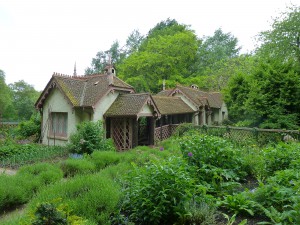
Duck Island Cottage in St. James Park

Duck Island Cottage in St. James Park

This resulted in numerous detours, delays, and unexpected surprises.  After running into Kristi and Hayley before the changing of the guard, I ended up wandering through St. James Park where I found a small cottage where the bird keeper used to live.  Then I saw two soldiers on horseback outside of the HouseHold Cavalry Museum and wandering under Admiralty Arch before finding my way to Westminster.  Even though I lost track of exactly where I was or where I was going, I ended up seeing parts of London which I did not have a plan to walk through.  This was also the strategy Annie and I used at Hampton Court Palace, Tate Modern, and the Portrait Gallery.  Even though we did have a few specific rooms, paintings, or portraits that we wanted to see, we did not make it our mission to seek those out first.  Rather, we just wandered around the various buildings taking in everything along the way and finding small treasures which we didn’t expect to see. 

Admiralty Arch

Admiralty Arch

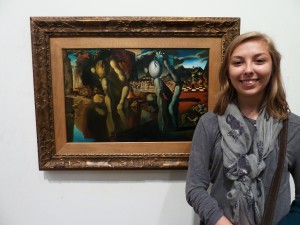
For example, we learned in Hampton Court Palace that ‘drawing room’ is actually short for ‘withdrawing room’ where many royals would ‘withdraw’ with other persons of power to conduct business.  We also accidentally found Weeping Woman by Picasso and the Metamorphosis of Narcissus by Salvador Dali in the Tate which were significant paintings for Annie and I respectively.  While meandering through the galleries we also discovered a favorite female surrealist artist who was previously unknown to both of us.  In the Portrait Gallery, I literally dropped my pen upon unexpectedly finding the portrait of John Donne which as featured on the cover of the autobiography which I read in a poetry class with Professor Gertz last fall.  We also successfully navigated the at times unnecessarily confusing bus system which felt like one of the biggest accomplishments we have achieved thus far.  All of these unexpected discoveries and happy mistakes have led me to find new and known items in different and surprising ways.  They have also underlined the importance of having an easy-going attitude while travelling and to remember that blunders can lead to some of the best learning experiences.

Metamorphosis of Narcissus - Salvador Dali

Metamorphosis of Narcissus – Salvador Dali

Posted in Uncategorized | Comments Off on Wanderful London

Woe in Wales

“Go to Wales they said. It’ll be a nice, easy day trip they said.”

-Anna Kathryn Barnes

Well, going to Wales was plenty nice, but easy it was not. First, due to some oversight AK and I took a bus all the way to Newport from Cardiff, only to be told we had to return back to Newport to get to the little town we were aiming for. Then, we arrived a little too late to go to the second site we planned to visit. And on top of that we had been accosted on the train by an Englishwoman for being too loud in the quiet carriage (for once, we weren’t being loud, obnoxious Americans; an Englishman who saw the whole thing even told us to keep talking because the woman was “a dozy cow”).

IMG_4171

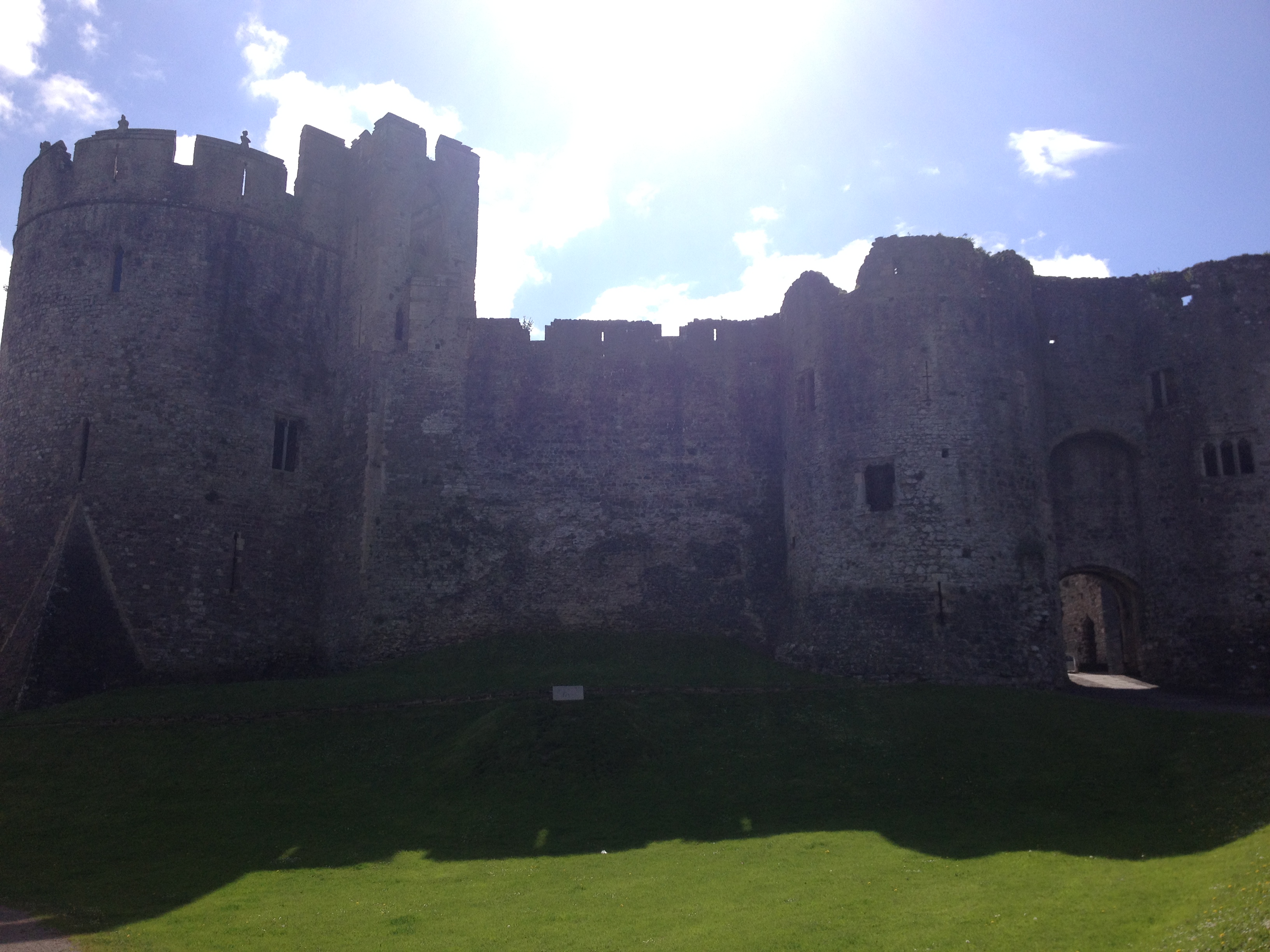
However, all these troubles seemed petty once we entered Chepstow Castle. Chepstow seems like one of those towns in movies or The X-Files that preys on unsuspecting tourists because all of the townspeople worship an obscure god that requires human sacrifices. However, Chepstow Castle is haunting in an entirely different way. Although it has been commoditized a bit (weak stuff, like safety precautions and the like) the castle is simply a ruin. It is extremely creepy in some places—there were little pockets that looked like something out of my nightmares—and mostly sad in others. Not in a way that was pathetic, but in a way that seemed almost sublime. Moss was growing on the stones, and even though the castle is in the middle of town it felt completely tranquil. I remember being disturbed by the fact that people had lived and breathed here, in the grandest sense, and now all their hard work was slowly crumbling into dust.


Posted in Uncategorized | Comments Off on Woe in Wales

All’s Well That Ends Well: Costumes as a Critique of Western Culture

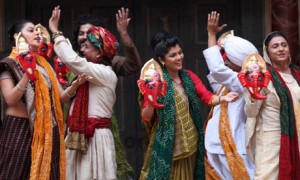
Sunil Shanbag’s version of All’s Well That Ends Well in Gujarati incorporated many traditional Bollywood aspects such as singing, dancing, music, and a critique of some parts of Western culture.  Due to the play being performed in a language which I do not understand, I ended up noticing many aspects of the performance which did not rely on speech.  Even though the play appeared to be very jovial and upbeat, using bright costumes, cheerful music, and many verbal jokes which parts of the crowd who spoke Gujarati understood, much of this joyfulness was lost on me and only served to emphasize the problematic aspects of the play even more.  I think it was Shanbag’s intention to take out any irony and create an uncomplicated comedy wherein all really is well that ends well based on the aforementioned cheeriness.  However, this merriment in direct contrast with the sad reality of what is actually taking place in the play only serves to reinforce the common label of ‘problem play’ on this production.  Heli (Helena) seems to genuinely act out of love for Bharatram (Bertram) despite his complete rejection of her.  She even smiles throughout her wedding scene while Bharatram attempts to escape and plead with Gokuldas Sawaram Bhatia (King of France).  The happy tone of the play also contrasted with the political statement that Shanbag made with his costume choices for Bharatram as well as Heli, Parbat (Parolles), and Alkini (Diana).

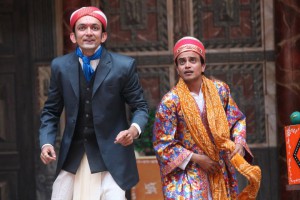
Bharatram begins the performance with his family in a less urban part of India in traditional Eastern dress along with the other characters.  He wears a traditional lungi and a turban during these opening scenes.

Bharatram wearing a mixture of Eastern and Western clothing.

Bharatram (left) wearing a mixture of Eastern and Western clothing.

As the play progresses and Bharatram reveals his business aspirations, his animosity towards his new wife Heli, and his desire for Alkini he begins to wear a Western suit jacket and tie with his lungi and turban underneath along with his companion Parbat.  At the height of his betrayal of Heli and his selfish business and personal interactions with Alkini, he has changed into an entirely Western style suit jacket, pants, and tie. This wardrobe transformation charts his character development from a collective mindset typical to Eastern culture which values community and family to a selfish Western value set and then back to Eastern values again. 

Bharatram in fully Western dress.

Bharatram in fully Western dress.

At the beginning of the play he is at home in a rural area of India with his mother, perhaps not upholding traditional Eastern values, but he is also not shown transgressing them.  However, when he leaves his rural town and goes to the urban center Mumbai to develop his trade business and begins to value making money more than staying with his unhappy mother, he begins to transition into Western clothing.  This indicates his departure from communal Eastern values and into a more selfish Western mindset.  He is also wearing this mixture of Eastern and Western style clothing when he marries Heli and when he rejects her in his letter.  These scenes also symbolize a rejection of communal and familial values; even though he is forced into marrying Heli he does shortly thereafter reject his new wife.  Then, when he decides to completely betray Heli, ignore any of Alkini’s wishes and attempt to force her into a moral transgression, while also forcing her hand in a business transaction, he is in completely Western dress.  This wardrobe change indicates his final rejection of traditional Eastern values.  He fully embraces selfish practices and dismisses any familial obligations which he may have. 

Bharatram in Eastern dress at the end of the performance

Bharatram in Eastern dress at the end of the performance

After Bharatram learns of Heli’s fake death and goes home to grieve and care for his mother, he returns to traditional Eastern clothing, moving back towards adopting Eastern values of caring for the family over oneself and accepts his wife.  Shanbag not only criticizes parts of Western culture with these costume choices, but also praises parts of Eastern culture and inherently makes a political statement.  He also follows a Bollywood tradition by doing this, but with a slight twist, primarily due to the plot of the play.  

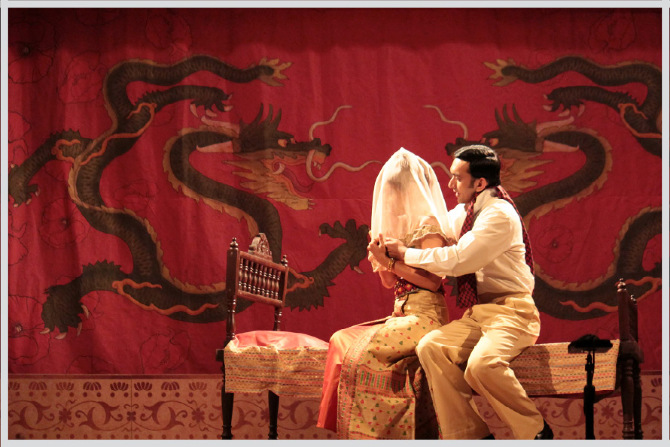
Many Bollywood films criticize Western tendencies of selfishness and consumerism through an Indian character who has immigrated to a Western country and adopted those values rather than maintaining Eastern values of family and community or through a person from a Western culture who has come into India with little respect for those traditionally Eastern values.  In most instances, these characters are male and are looking for a female partner to bring Eastern culture into their homes or the female is used to educate the Western male on Eastern principles.  While Shanbag does have Bharatram stay in India during his transition into and out of a Western value system which transgresses typical Bollywood tropes, he includes the more traditional concept of female characters as transmitters of culture.  Heli and Alkini conspire to bring Bharatram back to his family and his community throughout the play.  While Alkini is wearing slightly more Western style clothing, she is initially presented dancing with a mask and Eastern metal fingernail claws.  Heli is always shown in traditional Eastern clothing except when she is mirroring Alkini’s dress.  These costuming choices contribute to the sense that the women uphold Eastern traditions and values in contrast to Bharatram and Parbat’s Western influences.  Bharatram’s mother, Gokuldas Sawaram Bhatia, and the other characters from Bharatram’s home are also consistently dressed in Eastern styles.  By contrasting the Bharatram and Parbat’s costumes with those of the other characters’ in terms of cultural significance in this performance, Shanbag inherently praises Eastern communal values and condemns Western self-interest.

Heli in a traditional Eastern costume

Heli in a traditional Eastern costume

I found the costume decisions of Shanbag’s performance compelling and effective for a few reasons.  I felt that this interpretation was supported by the original text because Bertram does abandon his new wife and mother to pursue selfish interests before coming back and valuing his family more.  I also tend to concur that the Western value on self-interest is detrimental at times, so I agreed with this criticism on a fundamental level.  I was also impressed with Shanbag for taking the risk of making such a blatant criticism on a stage in a Western country with a large proportion of Western people in the audience.  Even though many of us could not understand what was being said on the stage, the costume choices were certainly significant enough to comprehend the cultural criticism, so I gained respect for Shanbag for that reason.  I also enjoyed that while he utilized a traditional Bollywood construction, the decision to keep Bharatram in India also indicated a criticism of urban Indian’s for adopting selfish Western values while also creating an internal character arc rather than simply allowing the audience to blame a Western culture for changing Bharatram.

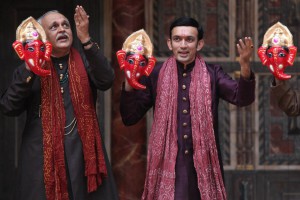
Numerous examples of Eastern costumes with Alkini in the center

Numerous examples of Eastern costumes with Alkini in the center

Posted in Performance Reviews | Comments Off on All’s Well That Ends Well: Costumes as a Critique of Western Culture

Week Three: London!

With my own graduation literally a week and a half away, here’s a recap of how I spent when of my penultimate weeks as an undergrad.

May 6: We started our first full week in London at a running pace. We arrived at the historic Globe theatre by ferry, just as Shakespeare would have done it. After a lecture on All’s Well That Ends Well, we got to see the production in Gujarati at the Globe. We broke for lunch briefly, before getting to see a more modernly staged version of King Lear at the National Theatre.

May 7: After the whirlwind of the previous day, we started the next day with a walking tour of the sites of Elizabethan and Jacobean theatres. Then it was time for one of my most anticipated performances: Titus Andronicus. Not only did I get to stand right in front of the stage for the whole show (I even got bleed on), but the class was treated to a Q&A session with two of the actors afterwards.

May 8: The day was welcomed with a gloriously free morning, which meant a chance to catch up on my sleep. Once the class was all roused and corralled, we had an acting/movement workshop at the Globe. We were then supposed to have an alumni event, but it ended up getting cancelled, unknown to us. Whoops.

May 9: Free day at Hampton Court Palace. Highlights from the palace include chilling with Henry VIII (casual), playing Marco Polo in the garden maze, and WEARING A CAPE!! Afterwards was lunch at the Mute Swan, wear I discovered my new favorite cider, making it a successful day all around, even before the class gathered together for a potluck dinner.

May 10: We welcomed the rainy weekend with a trip out to the Tower of London, which has some of the most awkward cobblestones I’ve seen in all of the UK (which is saying a lot). Besides all the super cool history inherit in exploring the tower, we also got to see the Crown Jewels (the sparkly one)!

May 11: After a beautiful and gorgeous morning that I was allowed to sleep through, I got to spend the afternoon exploring the British Library. Highlights include original manuscripts by Austen, Dickens, and Carroll, original lyric drafts from the Beatles, tones of obnoxiously pretty books, and an exhibit on comic books.

May 12: The class had one of its earliest mornings yet, having to be across town at nine, which meant more tube fun for everyone. Once we were all assembled (with our all-important coffee), we were treated to a tour of the Globe and a Q&A session about said theatre. Once that was completed, we had a brief break for lunch and exhibition wandering, and then another walking tour of some Shakespeare sites. Since the train ride back to our flats took us through King’s Cross, it was the perfect chance to snag the obligatory pictures at Platform 9 ¾. #SlytherinPride

Posted in Uncategorized | Comments Off on Week Three: London!

The Wheel of Fortune Where No One Wins

Sam Mendes’ adaption of King Lear takes a fatalistic approach to the tale of a devolving king, lessening the burden of tragedy that accompanies the play. The absurdity of King Lear throughout the performance within his actions and responses to other characters demonstrates this individual’s inability to cope with the prospect of growing old or dying, both of which represent actions out of his control. Mendes pairs this Lear with an unassuming Edgar, who becomes an embodiment of the wheel of fortune with the emphasis of time imagery and rhetoric that accompanies his character. As Lear succumbs to his fate at the end of the play and Edgar delivers the following epilogue, Mendes portrays the inescapable cycle of life. With his production of King Lear, Sam Mendes lessens the tragedy within the play by portraying the events as the inescapable fate that accompanies the end of life.

Sam Mendes creates an absurd Lear within the first scene of the performance, in which the royal family discusses the future of the kingdom, in order to show Lear’s inability to cope with the unknown nature of the future.  Mendes begins the scene with a commanding Lear, making him appear self-assured. As Lear enters to deliver his plan for the future at the start of the scene he walks upright with his shoulders back and moves to a purple chair center stage that has its back to the audience. While all of the other characters remain grouped together at a single table facing the audience, Lear commands over them with his singular position on stage. By not facing the audience and residing in front of the other characters, he appears much like a conductor in control over the situation. Mendes adds to the in control nature of Lear by having all of the characters remain standing until Lear motions for them to sit. He also places them into a boardroom-like setting with all of the others perched at a conference table. Lear’s purple chair also nods to the power he holds as a royal figure.

Mendes continues Lear’s in control attitude until Cordelia ruins his plans for the future of the kingdom, after which he breaks into a frenzy, to portray Lear’s discomfort with fate. After Cordelia decrees “Nothing, my lord” in response to his prodding for her declaration of love, Simmon Russell Beale begins screaming his lines. Instead of appearing hurt and somewhat understanding by giving her another opportunity to speak, Beale yells in Cordelia’s face during the line “How? Nothing will come of nothing try again.” This delivery makes Lear appear more irrational and ridiculously angry. Beale continues the absurdity of Lear’s anger by having him rant around the stage during his next few lines, knocking over chairs and tables along the way. Beale pauses halfway through his loss of control when he exclaims,

Here I disclaim all my paternal care,

Propinquity, and property of blood,

And as a stranger to my heart and me

Hold thee from this for ever (1.1.114-117)

Pausing at this proclamation makes it appear more radical and absurd in response to the simplicity of Cordelia’s rejection, revealing the true reasons behind his breakdown. Beale physically shoves a chair halfway through this portion of the speech at the line beginning with “and” to add to this insane feel. When Lear brings out Cordelia’s suitors he maniacally laughs while insulting his daughter both to the men and to her directly. During this part of the scene Lear laughs while physically pushing his daughter away, saying, “Go to, go to. Better thou/Hadst not been born than not t’ have pleased me better (1.1.242-243). This brutal banishment of Cordelia makes Lear appear mad in response to the uncertainty she causes within his future plans. Sam Mendes begins act one with a confident and in control Lear, when his future becomes less certain, Mendez devolves Lear into an extreme frenzy to show his inability to accept the uncertainty of life.

Mendes accompanies Lear’s insecurity with his future with a character meant to represent fate to demonstrate the impossibility of escaping the ultimate fate that accompanies the end of life. When Mendes first introduces Edgar, he portrays an extremely unassuming character. Edgar appears in baggy sweatpants and a t-shirt, which feels even less impressive as opposed to his brother’s suit within the same scene. Edgar also walks in smoking with a drink in hand and stutters throughout his first lines. This unassuming and pathetic character transforms after his fate changes within the play, highlighting his character’s relationship with fate. The next time Edgar enters the stage occurs during a scene in which Kent discusses fate and fortune. Kent decrees, “Fortune, good night. Smile once more. Turn thy wheel” (2.2.167). While Edgar enters and throughout his monologue that follows, the stage continues revolving to mirror these words of fate. This scene marks the first in which Mendes has the stage continuously revolve. The pathways on the stage take the form of clock hands during this continued rotation to mark the progression of time and the “turning wheel of fortune” that Kent mentions.

Within his first monologue Edgar also demonstrates his embodiment of fate with the sharp change in his character. Throughout this monologue Edgar remains upright and speaks directly to the audience, an action his previous self does not do. Tom Brooke also casts his arms out into the air as if throwing off his role as Edgar when he decrees, “That’s something yet. Edgar I nothing am” (2.3.22). Mendes also demonstrates how Edgar represents fate by having him physically represent the wheel of fortune throughout other scenes within the production and by changing the way in which he defeats his brother Edmund at the end of the play. During the heath scene and when Edgar and Gloucester encounter Lear in the fields, Tom Brook moves near Lear and sticks out one of his arms. He points the outreached arm at Lear, mimicking the “clock hands” that make up the stage and the turning wheel of fate. Edgar physically becomes the fate that follows Lear through his denial of his future.

The other way that Mendes has Edgar represent fate occurs as he murders Edmund. Mendes completely cuts the lines in which Edgar challenges Edmund and the two brothers duel. In the text Edgar directly challenges Edmund beginning with “Draw thy sword/That if my speech offend a noble heart/Thy arm may do thee justice/Here is mine” (5.3.135-137). In the performance Edgar announces his presence and without a word rightfully stabs Edmund in the ribs. Edmund does nothing in protest as if accepting that Edgar’s action represents a fate he must accept.

After Lear dies within the play, succumbing to the very fate that terrifies him at the start of King Lear, Edgar delivers the final lines of the play. The final relationship between Lear and fate becomes one of dismal acceptance for the audience. Edgar decrees,

The weight of this sad time we must obey.

Speak what we feel, not what we ought to say.

The oldest hath borne most. We that are young

Shall never see so much, nor live so long. (5.3.342-345).

Mendes has Edgar deliver these lines simply and slowly at center stage alone. The simplicity of the actor’s delivery of these final lines, along with Edgar’s deep tie to fortune makes the ending feel inevitable. Edgar doesn’t display any extreme emotions as if to suggest that although King Lear represents a tragic tale, it simply represents an overall acceptance of tragedy in life. Ultimately Mendes’ adaption of King Lear becomes an unsympathetic character accepting the future that he tries to defy, making his death and the other’s death less of an ultimate tragedy and more of simple acceptable fact.


Posted in Performance Reviews | Comments Off on The Wheel of Fortune Where No One Wins

A Fool’s Death

King Lear was definitely the performance I had been looking forward to most. I’m quite familiar with the play and was even in a production my freshmen year of college. All that familiarity, of course, meant that I had a lot of expectations, most of which I am sad to say weren’t quite met by this production. There were many excellent things about the show we saw, but there were also several uncomfortable choices made that really jolted me out of my theatre-going experience and back into my own head, where one thought kept repeating itself over and over: “This just isn’t right.


Lear’s fool was the most persistent and annoying of all the faults I saw in the production. Interestingly, although textually we don’t see the fool appear until the fourth scene of the first act, this production chose to have him visible behind King Lear’s throne in the opening scene. He crouched in the shadows there, sitting on his suitcase. From the very beginning, it was clear this production was going to do something radically different with their fool. I was not at all prepared to dislike their choice as much as I did, however.

This production of King Lear seems to have been in a semi-modern setting; King Lear himself is dressed as a military dictator, and his daughters wear clothing that wouldn’t have looked out of place in the early 1940s. They seem to be going for a post-World War II sort of idea. Given this, we might expect the fool to be dressed like an ex-soldier, returned home after the war, or perhaps any kind of beggar or homeless person. Instead, we are given a fool dressed at the height of fashion: from his immaculate suit to his leather suitcase and round, bright-colored glasses, the fool comes across more as a high-level government official and trusted adviser to the king rather than a low-class peasant whose pointed comments are tolerated because of how amusing they are.

Nothing in the text or that I can find about Elizabethan fools themselves seems to support such a well-dressed, high-class fool. Fools were usually employed to provide frank and humorous advice to their patrons, but they were typically dressed as servants or dressed gaudily to enhance their amusement factor. In fact, the tidy, proper dress of director Sam Mendes’ fool may actually be inhibiting the fool’s purpose: to be funny. Few of the fool’s antics really had me laughing, with the exception of the line he delivered while straddling the dead stuffed moose on the dining table. His incredibly uptight dress really seemed to hamper his ability to make me laugh.

Lear’s relationship to his fool is also incredibly troubling in this production. The king is shown to lean heavily on the advice and care of the fool simply by the way they relate to each other on stage. In act three, scene two, the fool is quite literally the only thing supporting and keeping the aging king from toppling off the raised platform where he delivers his “Blow, winds, and crack your cheeks!” speech. Yet despite this strong physical connection, Lear bludgeons his fool to death in the infamous trial scene. There are many ways to handle the disappearance of the fool after the third act, but such an incredibly violent end for the fool is rare and quite unsuggested by the text itself. Lear seems to imagine one of the daughters he has put on “trial” is escaping and exclaims the lines, “Arms, arms, sword, fire! Corruption in the place! False justicer, why hast thou let her ‘scape?” The text leads us to believe he’s shouting at a vision of both his daughter and her jailor, yet it is at this point in Mendes’ production that Lear brutally turns on his fool and bludgeons him to death inside a bath tub, discarding the bloody pipe he has used to do so when he is finished. This might make some sense if the fool had been up and about, or at least in the middle of the stage where Lear was looking. He’s not, though: he’s sat behind Lear on the rim of the bath tub that will soon become his coffin. Why should Lear turn on his fool when he doesn’t even seem to be in the field of view for this vision?

Gloucester later re-enters and asks where Lear is, to which Kent replies “Here, sir; but trouble him not, his wits are gone.” It’s possible that Mendes thought the best way to show the loss of Lear’s wits was to have him kill his own fool, but besides the obvious textual inconsistency of such an action, there’s another problem that pops up at this point: no character makes any sort of reaction to the fool’s death. At the very least, there ought to have been some sort of non-verbal acknowledgment of the fool’s tragic end. But no: Mendes’ production ticks on inexorably, every character seemingly unconcerned about this brutal murder.

The utter lack of acknowledgement does not sit well with me at all. I barely had time to process the fool’s death during the production and so I have dwelled on it since, constantly wishing that this choice had not been made. Even though I wasn’t a fan of this production’s interpretation of the fool, this gruesome end, practically ungrounded in the play’s text, made everything ten times worse. First, Mendes gave me a fool I could not laugh at, and then he took him away in a brief patch of violence I could not process.

Posted in Performance Reviews | Comments Off on A Fool’s Death