
Sunil Shanbag’s version of All’s Well That Ends Well in Gujarati incorporated many traditional Bollywood aspects such as singing, dancing, music, and a critique of some parts of Western culture. Due to the play being performed in a language which I do not understand, I ended up noticing many aspects of the performance which did not rely on speech. Even though the play appeared to be very jovial and upbeat, using bright costumes, cheerful music, and many verbal jokes which parts of the crowd who spoke Gujarati understood, much of this joyfulness was lost on me and only served to emphasize the problematic aspects of the play even more. I think it was Shanbag’s intention to take out any irony and create an uncomplicated comedy wherein all really is well that ends well based on the aforementioned cheeriness. However, this merriment in direct contrast with the sad reality of what is actually taking place in the play only serves to reinforce the common label of ‘problem play’ on this production. Heli (Helena) seems to genuinely act out of love for Bharatram (Bertram) despite his complete rejection of her. She even smiles throughout her wedding scene while Bharatram attempts to escape and plead with Gokuldas Sawaram Bhatia (King of France). The happy tone of the play also contrasted with the political statement that Shanbag made with his costume choices for Bharatram as well as Heli, Parbat (Parolles), and Alkini (Diana).
Bharatram begins the performance with his family in a less urban part of India in traditional Eastern dress along with the other characters. He wears a traditional lungi and a turban during these opening scenes.
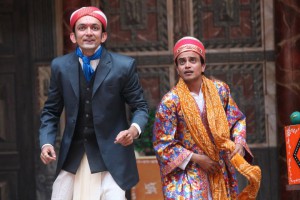
Bharatram (left) wearing a mixture of Eastern and Western clothing.
As the play progresses and Bharatram reveals his business aspirations, his animosity towards his new wife Heli, and his desire for Alkini he begins to wear a Western suit jacket and tie with his lungi and turban underneath along with his companion Parbat. At the height of his betrayal of Heli and his selfish business and personal interactions with Alkini, he has changed into an entirely Western style suit jacket, pants, and tie. This wardrobe transformation charts his character development from a collective mindset typical to Eastern culture which values community and family to a selfish Western value set and then back to Eastern values again.
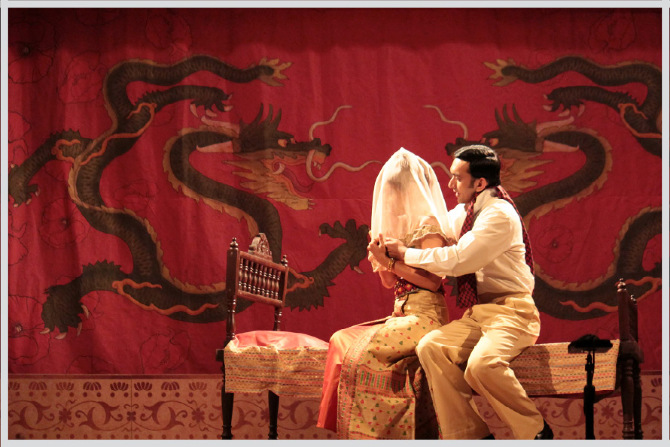
Bharatram in fully Western dress.
At the beginning of the play he is at home in a rural area of India with his mother, perhaps not upholding traditional Eastern values, but he is also not shown transgressing them. However, when he leaves his rural town and goes to the urban center Mumbai to develop his trade business and begins to value making money more than staying with his unhappy mother, he begins to transition into Western clothing. This indicates his departure from communal Eastern values and into a more selfish Western mindset. He is also wearing this mixture of Eastern and Western style clothing when he marries Heli and when he rejects her in his letter. These scenes also symbolize a rejection of communal and familial values; even though he is forced into marrying Heli he does shortly thereafter reject his new wife. Then, when he decides to completely betray Heli, ignore any of Alkini’s wishes and attempt to force her into a moral transgression, while also forcing her hand in a business transaction, he is in completely Western dress. This wardrobe change indicates his final rejection of traditional Eastern values. He fully embraces selfish practices and dismisses any familial obligations which he may have.
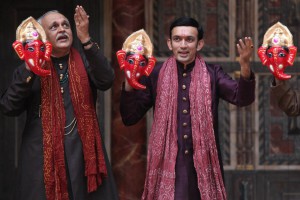
Bharatram in Eastern dress at the end of the performance
After Bharatram learns of Heli’s fake death and goes home to grieve and care for his mother, he returns to traditional Eastern clothing, moving back towards adopting Eastern values of caring for the family over oneself and accepts his wife. Shanbag not only criticizes parts of Western culture with these costume choices, but also praises parts of Eastern culture and inherently makes a political statement. He also follows a Bollywood tradition by doing this, but with a slight twist, primarily due to the plot of the play.
Many Bollywood films criticize Western tendencies of selfishness and consumerism through an Indian character who has immigrated to a Western country and adopted those values rather than maintaining Eastern values of family and community or through a person from a Western culture who has come into India with little respect for those traditionally Eastern values. In most instances, these characters are male and are looking for a female partner to bring Eastern culture into their homes or the female is used to educate the Western male on Eastern principles. While Shanbag does have Bharatram stay in India during his transition into and out of a Western value system which transgresses typical Bollywood tropes, he includes the more traditional concept of female characters as transmitters of culture. Heli and Alkini conspire to bring Bharatram back to his family and his community throughout the play. While Alkini is wearing slightly more Western style clothing, she is initially presented dancing with a mask and Eastern metal fingernail claws. Heli is always shown in traditional Eastern clothing except when she is mirroring Alkini’s dress. These costuming choices contribute to the sense that the women uphold Eastern traditions and values in contrast to Bharatram and Parbat’s Western influences. Bharatram’s mother, Gokuldas Sawaram Bhatia, and the other characters from Bharatram’s home are also consistently dressed in Eastern styles. By contrasting the Bharatram and Parbat’s costumes with those of the other characters’ in terms of cultural significance in this performance, Shanbag inherently praises Eastern communal values and condemns Western self-interest.
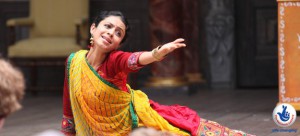
Heli in a traditional Eastern costume
I found the costume decisions of Shanbag’s performance compelling and effective for a few reasons. I felt that this interpretation was supported by the original text because Bertram does abandon his new wife and mother to pursue selfish interests before coming back and valuing his family more. I also tend to concur that the Western value on self-interest is detrimental at times, so I agreed with this criticism on a fundamental level. I was also impressed with Shanbag for taking the risk of making such a blatant criticism on a stage in a Western country with a large proportion of Western people in the audience. Even though many of us could not understand what was being said on the stage, the costume choices were certainly significant enough to comprehend the cultural criticism, so I gained respect for Shanbag for that reason. I also enjoyed that while he utilized a traditional Bollywood construction, the decision to keep Bharatram in India also indicated a criticism of urban Indian’s for adopting selfish Western values while also creating an internal character arc rather than simply allowing the audience to blame a Western culture for changing Bharatram.
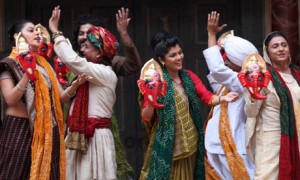
Numerous examples of Eastern costumes with Alkini in the center