
 Throughout The National’s production of King Lear, I was captivated with the idea of the three daughters as three very distinct female archetypes – the bitch, the whore, and the innocent. King Lear’s eldest daughter, Goneril, is obviously depicted as the bitch character in the play, Regan, the middle daughter, is depicted as the sexualized and attention craving whore, and the youngest of the three, Cordelia, is depicted as the virtuous and pure innocent figure. I found this idea quite striking, as all three daughters are introduced in the opening of the play wearing three distinct gemstone colored dresses, which vividly identify these three personas. By portraying Goneril, Regan, and Cordelia in emerald, ruby, and sapphire, the director establishes them as three gems with three very distinct personalities, but one common thread, the fact that they are constrained to these formulaic female roles.
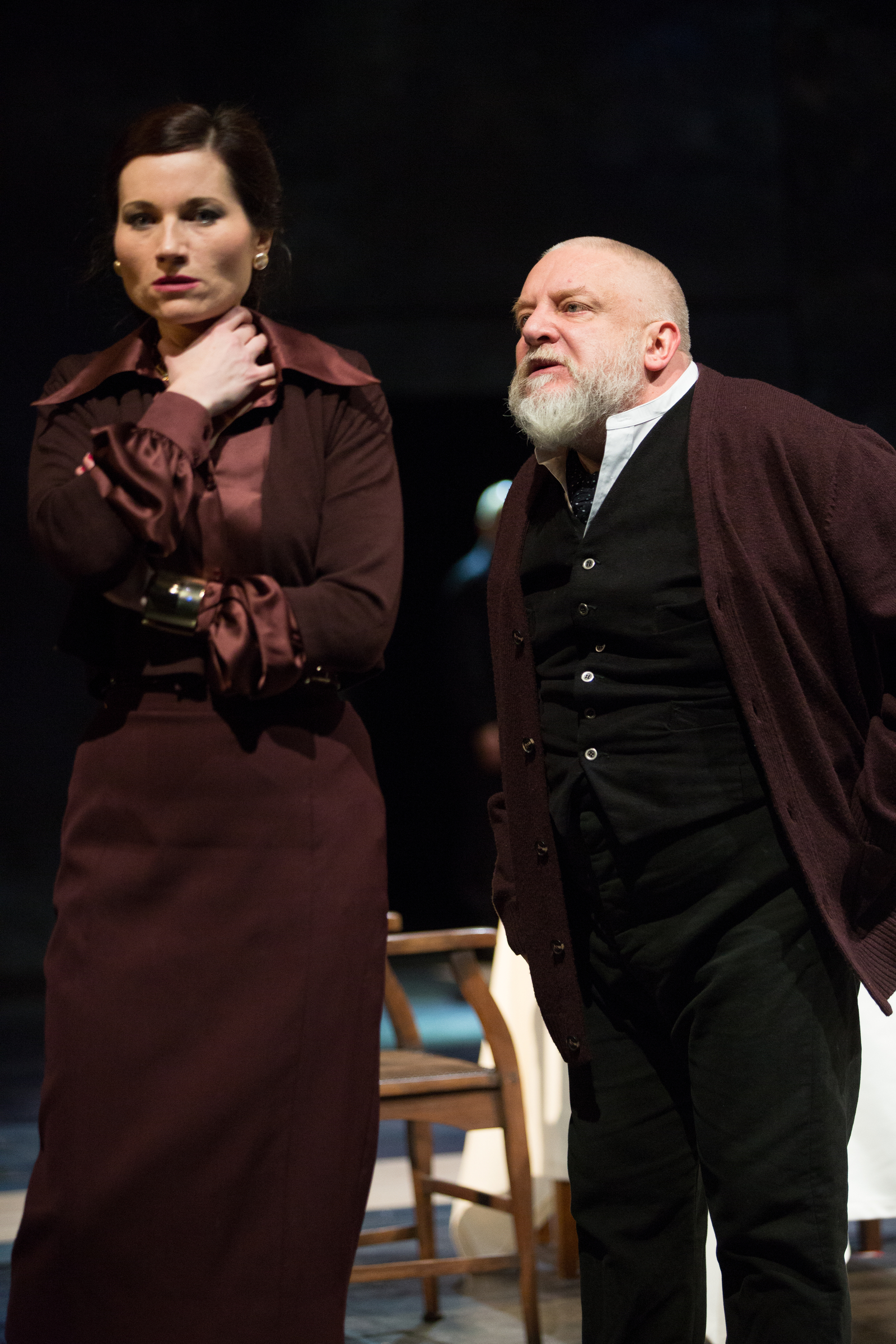 Goneril, the eldest of King Lear’s three daughters is first introduced in the play as a rather frigid and controlling character, which is stressed by her first costume choice. In this scene she wears a high-necked emerald green dress, which is slightly longer than knee length and is long sleeved as well. The dress is made out of a tight fitting and rigid fabric (possibly a polyester), as if it is encasing her body and controlling her movements. Much of her body is covered by the dress, as if she is reserved and essentially blocked from the rest of the world by fabric. Stereotypically, the dress also has a pear collar, which is reminiscent of a 1950s housewife or an uptight modern woman. Goneril’s hair is also in a very tight up-do in this opening scene. Her hair is slicked back and pulled into a neat bun shape, which reflects her uptight personality in the play. What is most interesting about this wardrobe choice, however, is the decision to put Goneril in an emerald green dress. This color dress mirrors the emerald gemstone, which is often thought of a stone of power and envy. The fact that Goneril is first shown on stage wearing this color plays into the “bitch” figure she plays in the rest of the play. She is controlling, abrasive, violent, and conniving, and the green dress hints at this nature before she even begins speaking.
 Regan is also first shown wearing a dress, only hers is a very low cut deep ruby colored dress. Her gemstone colored dress is shorter than her elder sisters, at about knee length, with quarter length sleeves and has an entirely different shape. Regan’s dress is made out of a stretchy and flowing velvet-like fabric that gives off a sensual vibe. It clings to her body in a way that shows off her hips and breast more than Goneril’s dress as well. She also wears a pair of black pumps, which sexualizes her, as her legs appear longer. Regan is introduced as the only blonde sister. Her hair is full of body and though straight, has a sort of beach-like wave at the ends, which resembles sex hair in a way and hints at her lustful nature. She is portrayed as a sexually aggressive character in the play, which is only emphasized by the ruby color of her dress. The ruby is often called the love stone and is said to represent passion and sexual love. By dressing Regan in this color, the director is establishing her as the most carnal of the three sisters.
 Just like her sisters, Cordelia first appears onstage wearing a gemstone colored dress; in her case it is sapphire blue. This dress is similar to Regan’s in shape, however it is slightly baggier, longer, has pleats, and reveals less cleavage. Though the dress has a similar cut to Regan’s, Cordelia’s dress has a higher neckline and her bust is smaller so she does not fill it out as much. Cordelia does not show any cleavage, which makes her appear more innocent than Regan. Her dress is also looser and flows more than Goneril’s so she appears more whimsical than her eldest sister. Cordelia’s hair in this scene is also quite angelic, in that it is full of soft curls resembling a little girl’s hair, or a longer version of the hair you would see in the painting of a cherub. Again, the color of her dress is notable, as it is sapphire blue, which is known as a heavenly stone of wisdom and Divine favor. It is considered the stone and color of the search for spiritual truth. This strong connection to the Devine suggests the stone color is a source of innocence. Sapphires are also said to represent dignity, loyalty, and purity. The blue coloring represents a sense of serenity and calm and present Cordelia as the pure and innocent sister.
Though the daughters no longer wear these three colors in the rest of the play their outfits, demeanor, and interactions with other characters mirror the personas assigned to them by the colors of their correlating gemstones in the beginning of the play. The depictions of the three daughters as the stereotypical bitch, whore, and innocent roles at the beginning of the play relate back to the theme of being cast into specific roles in life based on birth. These three female characters are forced into their specific roles because of birth order, just like Edmund is born into his role as the bastard. As the eldest, Goneril is forced into her role as the responsible and more high-strung character. Regan is the most sexualized character, as the middle child in families often gets less attention and has to find other ways to be noticed. Finally, the youngest child in families tends to be babied and favored because he or she is the youngest, which explains why Cordelia is cast as the most innocent and pure of the three sisters. The three opening jewel toned dresses, in turn, assign the bitch, whore, and innocent roles to each of the three daughters, emphasizing the theme in the play that people are often cast into identities they cannot escape in life.