
We saw the first part of Shakespeare’s King Henry IV on Shakespeare’s birthday in the town where the bard was born 450 years ago. The performance was electrifying, but even before the show began we were presented with a striking set and theological props. As we waited for the show to start, I was curious as to how the director, Gregory Doran, would incorporate this set into the opening scene. By the end of the show, it was apparent that Doran chose to open with a crucifix and the image of a stained glass window because he wanted the audience to think about these characters’ relationships with religion and sin, especially King Henry, Hal, and Falstaff.
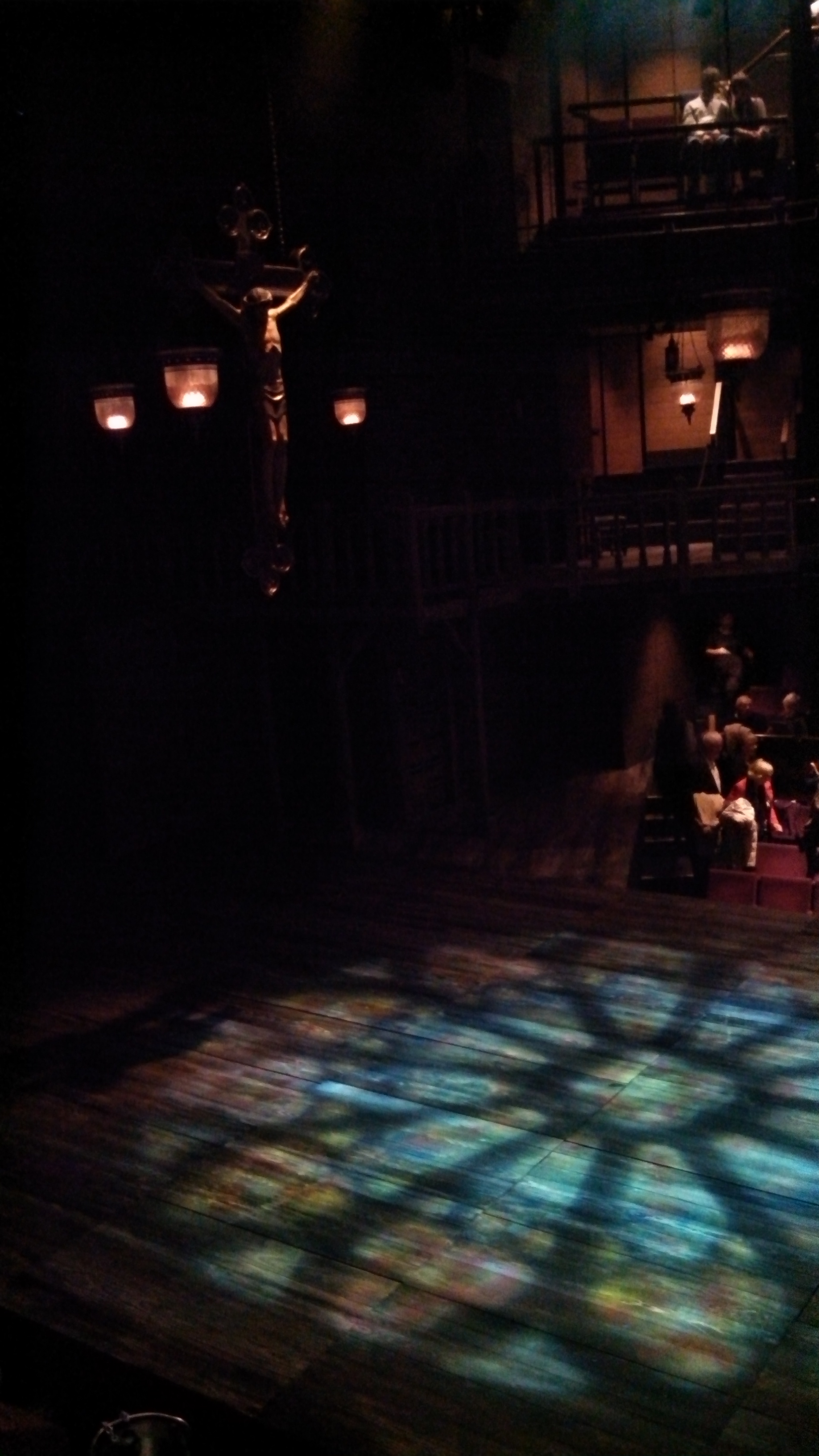
Crucifix and Stained Glass Window
I had always imagined the play opening with Henry IV, formerly Henry Bolingbroke, sitting on his throne, addressing his court. This was not the direction Doran went in at all. Suddenly, the lights went down. All was still for a moment before cloaked figures toward the back of the stage carrying candles started a procession forward. They drew my eye, and it took me several more moments to see the figure lying face down and spread-eagled in the center of the stage. He was entirely shrouded; I honestly wasn’t sure who he was at first. The crucifix above seemed to mirror his position. I saw this choice as Doran’s deliberate attempt to suggest that the front of the cloaked figure was, if not Jesus himself, a truly Christ-like figure. When the shrouded man rises and begins to speak, we see that he is clearly King Henry IV. In this beginning scene, there was also a ghostly Richard figure observing these activities. From the very beginning, Doran establishes a strong link to Christianity and reminds of us Bolingbroke’s intense guilt over the death of Richard II. This only enhances the play’s emphasis on the heavy weight rulers bear.
The audience is never allowed to forget that King Henry is uneasy on his throne. Rarely does he wear the crown on his head. Instead, he tends to carry it by his side in most scenes. Doran’s Henry IV comes across as deeply troubled because of this. We also see him making the sign of the cross at significant moments in the play, most notably when he is found leaning over the dead body of Lord Blunt by Lord Douglas. After Douglas announces his presence, the King immediately makes the sign of the cross before standing to engage in battle. Though he is riddled with guilt for his actions, the King still looks to God to guide him. We can see his battle with Douglas as a truly defining character moment, where he throws himself into battle hoping that, by the grace of God, he will survive. Surely if God approves of King Henry’s deposal of Richard, he will allow him to win the battle. By engaging in battle with Douglas, King Henry likely believes that he will discover for once and for all whether his usurpation of the throne was a sinful action in the eyes of his God. Prince Hal saves the King from certain death, proving to King Henry that God sanctions his actions.
If Henry IV is the central Christ figure of the play, what then is Hal? Shakespeare gave us a prodigal-son Hal, and the actor Alex Hassel, gives us a likable, winning portrayal of the Prince. He draws a laugh from the audience in his monologue, something that surprised even Shakespeare scholar Nick Walton. Though in the beginning he sins freely and with much abandon, by the end of the play he has redeemed himself in the eyes of his father. Because of the strong ties Doran created earlier in the play between King Henry IV and Christ, this is as good as Prince Hal being redeemed in the eyes of God as well. Hal, then, is suitable to bear the burden of rule only after he has proven himself. Doran’s vision seems to tell us that only certain kinds of people are capable of exercising power, and those people are morally upright, which in Shakespeare’s era meant they had to be Christians who aimed to minimize the amount of sins they commit.
Falstaff, on the other hand, never comes close to redeeming himself and is therefore a perfect example . Several times throughout the play, we see him swear off drinking, only to see him return to it quickly. In Act 1 Scene 2, where we meet Falstaff for the first time, we see his hands shake early in the morning before he has drank any alcohol. Falstaff is an alcoholic who experiences withdrawal whenever he stops drinking for a time. This choice, whether it was something decided by Doran or the actor Antony Sher, allows the audience to feel a great deal of sympathy for Falstaff. He is someone who tries to do the right thing but simply cannot because of his addiction.
We can think of King Henry, Prince Hal, and Falstaff as different points along a continuum of sin. King Henry commits his worst sin without meaning to and later devotes his life to cleansing his soul. Prince Hal sins out of boredom, waiting for the day when he can cast off his inappropriate lifestyle and embrace the position into which he was born. Falstaff sins constantly. Though he occasionally regrets his actions, he finds it impossible to change.