
The theme of the commodification of people through dehumanizing stereotypes is quite evident throughout Holly Findlay’s production of Arden of Faversham. Prior to seeing the play I recognized this theme in the play by looking at the lack of value many characters place on Arden’s life and the ease in which they attempt to kill him, but seeing the play made the theme all the more prevalent. The theme of commodification in general is heightened in the play through making Arden a knick-knack factory owner, but it is also apparent in the way the various characters are physically portrayed. Through wardrobe choices, the major characters are portrayed as commodities that could be replaced at any time by other similar people. By dressing the characters in hyperbolic, stereotypical costumes, the play shows how people have become dehumanized and made into commodities, like the objects people in the modern world surround themselves with.

Alice Arden’s hair style was reminiscent of the Jersey Shore “poof,” though the hair was pulled into a slight ponytail onto her right shoulder
Alice is portrayed as the lower class, potentially gold digging, and unsatisfied trophy wife. Though her speech and affair hint at this, her tight clothing, gaudy jewelry and bright makeup emphasize this characterization. Alice wears a tight, knee-length, brightly colored, floral print skirt with black accents and a low-cut, V-neck, brightly colored floral blouse, which clashes with the print of the skirt. The two pieces look expensive, but the overuse of patterns and bright colors show she does not know how to dress tastefully. They show that she has money to buy expensive things, but that she must not come from money because she does not know how to wear them properly. She also wears pointy, closed toed stilettoes that are black and cream colored, which stray from the classic pump, and clash further with the rest of her outfit. Finally she wears lots of gold jewelry, including multiple bangles, bracelets, and necklaces. She wears three necklaces at one point in the play, as if she never learned the “take off the last accessory you put on” rule. Her hair finishes off her outfit. It is styled with a quite large back poof that resembles a “bump it” improved half-up-do. It is very big, and curled like trashy women on shows like The Jersey Shore wear. In this attire and hair, Alice becomes a representation for women like her and is no longer simply herself.
Mosby is depicted as a middle-class scammer, who is attempting to fit in with the rich, but is failing miserably. He is stereotyped as the suave, but tasteless man. This is shown in his choice to wear a nicely tailored, but slightly baggy, grape purple suit. Throughout the play he appears in a loose deep purple jacket and pants, with a silk purple button up shirt, a Barney colored tie, and purple socks. The only two things he wears that aren’t purple are a pair of dark brown or black shoes and a silver tie clip. The silk or satin shirt emphasizes the suave nature of the character, while the purple shirt and overly tan skin (like he is wearing to much bronzer) make him look tacky, like a used car salesman.

Sperry Top Sider boat shoes, actual boat not required, but strongly recommended
Sir Thomas Cheyne’s attire stereotypes him as a rich and preppy college boy. Though his neon blue and yellow Nike workout gear is quite striking in the play, the most notable outfit for Sir Cheyne is his ending costume. This costume is the stereotypical snobby and preppy upper-class male attire. It consists of Sperry Top Siders, well-tailored khakis, a button down shirt and a sweater wrapped around his shoulders, like he just walked out of a Brooks Brothers or JCrew catalog. The first moment I saw him on stage I thought I had been magically transported back to Washington and Lee and was looking at a “frat star.” With the country club attire and British accent, Sir Cheyne is stereotyped as a rich and preppy Oxford or Cambridge boy.

Classic Adidas running pants
Greene is depicted as a low-class “hoodie,” as the British call them, who sees himself as a businessman. He wears, what I am assuming to be, a fake diamond stud in his left ear and is dressed in a head-to-toe Adidas tracksuit. His jacket is black around his stomach and is a printed pattern of multicolored Adidas labels on his arms and upper torso, while his pants are black, with the classic Adidas white stripes along the outer sides. On the first night of the performance he also wore a dark pair of Adidas sneakers. As for hair, his head is shaved around the sides with a greased back, longer section on the top that is tied together into a small ponytail. In the play he looks and acts like a stereotypical low-class Irishman. Personally, he made me think of an Irish traveller.
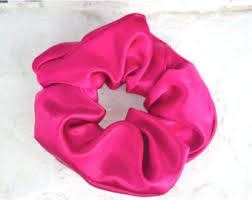
Hot pink scrunch worn by teens in the 1980s and 1990s, and now by sad looking women in their 40s who cling to their youth
Mrs. Reed is stereotyped as the struggling, working-class woman. In the play she wears a green uniform with a blue and pink paisley shirt underneath and occasionally a burnt orange sweater over it. She wears her hair in a messy ponytail, with a hot pink scrunchie and she wears comfortable looking pale blue shoes (similar to a pair of Toms, but not as trendy). Mrs. Reed also keeps a bible in pocket and a cross around her neck, emphasizing the fact that she clings to her religion to get her through her miserable life. She is epitome of the struggling, blue-collar woman.

Dom from Something About Mary
Clark is stereotyped as the weird, stalker, and potential serial killer character. He wears a drab outfit that allows him to blend in and go unnoticed. This outfit consists of light tan colored khakis, a camel colored zip up jacket, a pale blue button up shirt, and a pair of dorky Miami vice sunglasses, which he pushes against his nose. He wears his pants high on his waste so that he appears stereotypically nerdy, like an Urkle character, and has greasy hair, which again makes it uncomfortable to look at him. Overall, his attire, behavior, and red rash on his cheeks are reminiscent of a stalker boyfriend character in the movie Something About Mary. He is stereotyped as creepy character based on his attire, which makes it even more unsettling to look at him when he is doing creepy things like smelling Susan’s hair.
The overall stereotypical costumes in the play emphasize how stereotypical each of the individual characters is, but I saw this as a good thing. By stereotyping the various characters in a visual way, it became clear that they mirrored archetypes that most people automatically recognize, like the cheating gold-digger, the snob, the worker, and the creeper. Though some may critique these exaggerated characterizations, saying they are over the top, I argue that the vividness of these stereotypical characters makes them relatable to the audience. We can all recognize people we know, or pieces of ourselves in each of the characters, which makes us care about them and their fates. Overall, by stereotyping the characters with costumes, the play makes the characters recognizable and in turn sympathetic.
(Note: I am actually under word count by 100 words, but the captions on the pictures are added into the official count for some strange reason)