
When I walked into the Royal Shakespeare Company’s theater, the large crucifix hanging from the ceiling immediately stole my attention. Not only that, but the center of the stage floor was lit in Cathedral stained glass as well. These Christian elements undulated throughout the RSC’s performance of 1 Henry IV, giving me new insight into Shakespeare’s text. Director Gregory Doran’s addition of Christian elements in this performance emphasized the true weight of the crown, adding depth and clarity to the Shakespeare’s characters.
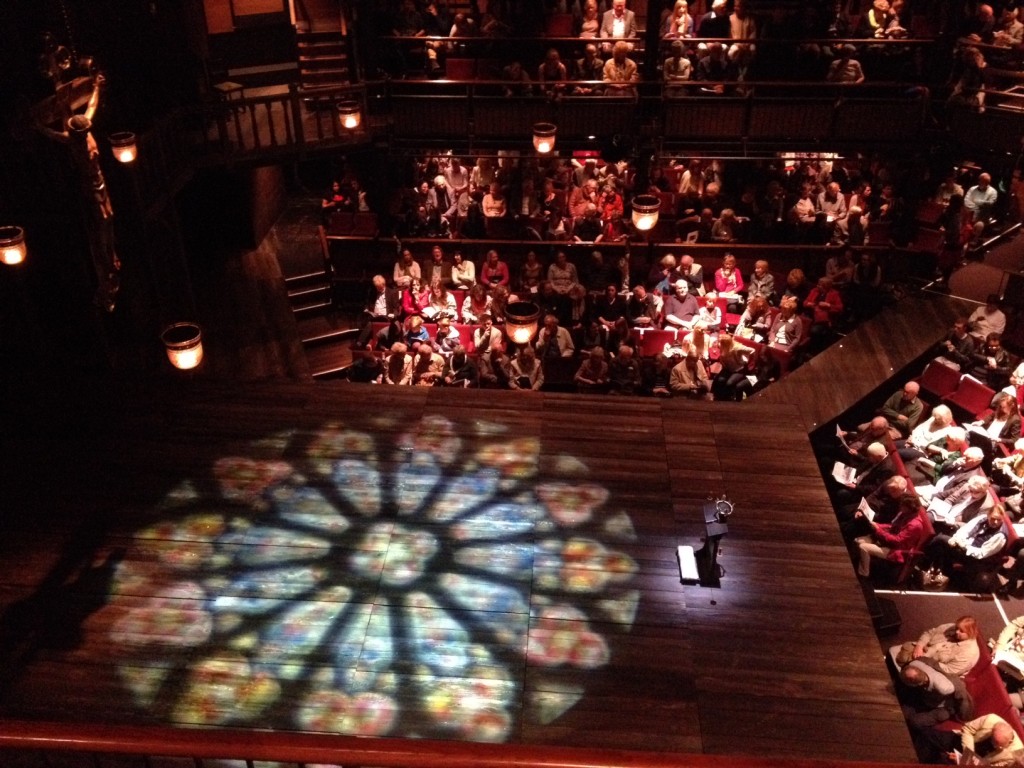 The opening scene of 1 Henry IV presents an interesting dilemma to directors. How much background from Richard II does the audience need? Doran addressed this problem with Christian props and music. I Henry IV with King Henry prostrate on the stained glass lit floor and thus anonymous to the audience, at first. He then stands and paces the stage, clearly burdened by the crown which sits on a communion prayer stool at the stage’s head. This combination of lighting, crucifix, prayer stool, and the haunting Church bells elucidate Henry’s torment and guilt.
Although it disappears temporarily after the weighty first scene, the presence of the crucifix both early in the play and later at pivotal scenes also casts new light on the play’s themes. For example, Christian elements give new complexity to the play’s theme of fathers and sons—the crucifix made me wonder if Hal is a prodigal son, and perhaps Henry is a bedraggled and guilt-ridden. Jasper Britton’s portrayal of Henry’s unease combines with the Christian overtones, rendering him as a God agonizing over his role as king—and perhaps his son. In this sense, then, Doran interprets Shakespeare’s text as a commentary on the trials of ruling, the burden and sacrifice required to rule a weakening nation.
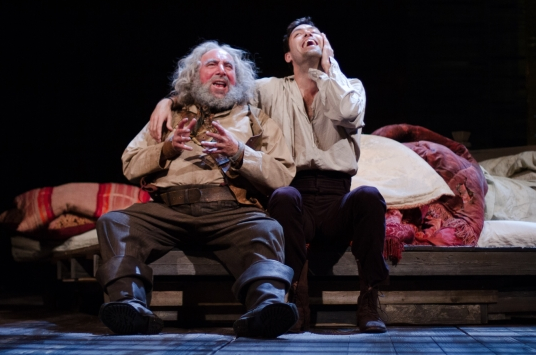
Much like Hal’s character could be seen as a prodigal son, Antony Sher plays a Falstaff who is both a great “sinner” and is as jovial and full of life on stage as he is in on the page. Sher performs Falstaff as a man who is both honestly and selfishly full of life. In the second half of the play, Falstaff tries and fails three times to quit drinking his “sack” before returning it to his red-nosed face with trembling hands. This characterization of alcoholism adds a layer to Falstaff that makes him both more sympathetic and more sadly lovable, despite his disregard for the lives of others. For example, when he describes his men as “food for powder,” they march behind him in a manner reminiscent not of martyrs, but rather of shadowy, anonymous sinners. Falstaff’s casual dismissal of their lives coupled with their chilling march in the background of the stage evokes a funeral procession.
This dark scene grows darker when Hal shakes his head to his former friend in a way that seems both sad and resentful. It is as though he feels disappointed in Falstaff, an un-holy father figure but knows there is nothing he can do to change him. Again, the more subtle Christian elements of this scene emphasize the play’s theme of father hood and the greater the difficulties of Kingship.
Moreover, Doran interprets Hal’s early soliloquy describing his plan to “imitate the sun” as Christian imagery. Hal shirks his former friends and steps into the role his father desperately needs him to play. Henry’s desperation comes to a peak towards the play’s end, when the play takes another stark turn in energy. Act 3 Scene 2 opens with eerie Church lighting and crucifix. Just as in the first scene, these bold symbols highlight the scene’s thematic significance, not just in terms of Hal and his father’s relationship, but also for the fate of England. Hal bears resemblance to Christ. Doran must take the stance on the original text that rather than a manipulative or even sociopathic frat star; Hal embodies a son who has to journey to the ultimate sacrifice in order to fulfill his royal duty. The triumphant and almost regretful killing of childish Hotspur makes Hal seem wiser rather than wickeder. Though Hal is not physically crucified, the Falstaff within him—both his sin and his life—dies as the play ends.
 These Christian elements that fade in and out of prominence had a significant, positive effect on my viewing experience and on my interpretation of Shakespeare’s text. On the one hand, there are clear flaws in the Christ/Hal parallel. However, a Christian reading gives the already brilliant text an even stronger historical significance. Did Shakespeare intend to portray Hal as Christ-like? Are Falstaff and his friends truly sinners? Perhaps we should read Shakespeare’s text as a commentary on both the nature of virtue and royal duty as well as a commentary on the sacrifices required to be a strong King. The RSC’s performance raises these questions with a never-wavering level of energy and incredible acting that kept me entertained for the full two hours. Doran adds the Christian element that was undoubtedly on Shakespeare’s mind as he crafted it. This performance of 1 Henry IV evocative of both a history and a Christian archetype, casting its characters and significance into light that made a bright, colorful impression.