
When I first read Titus Andronicus, I pictured Tamora as a character whose actions were somewhat justified as a result of the suffering she had endured by the hands of Titus and his fellow Romans. After her pleas of mercy on behalf of her eldest son had fallen on deaf ears, she was emotionally hardened and became a cold-blood manipulator hell-bent on avenging both her murdered son and her people. This characterization of Tamora somewhat complicates the play, as the character who might be seen as a straightforward antagonist becomes a sympathetic character. However, a portrayal of Tamora within this framework would be extremely discordant with the over-the-top, Quentin Taratino-esque stylistic decisions made by director Lucy Bailey in the Globe Theater’s production of Titus Andronicus. The Tamora in this performance, played by Indira Varma, downplayed many of the sympathetic or positive attributes of her character to make Tamora more traditionally antangonistic. Varma’s Tamora is less of a cunning and manipulative woman filled with bloodlust, and could perhaps more accurately be described as an evil seductress who relishes in her own misdeeds.
The relationship between Tamora and Matthew Needham’s Saturninus in the play reflects many of the attributes of the characters that were simplified for this more comedic production. For example, Tamora does not control Saturninus using superior intellect or cunning, but simply her feminine charms. Needham’s Saturninus is an arrogant, immature emperor who seeks approval for his own actions. On several occasions, he laughs at his own jokes, or even gestures for the audience/other characters around him to also appreciate his humor. Saturninus is an arrogant playboy who seems quite full of himself. This portrayal enables the character of Saturninus to seem even more easily manipulated by Tamora than in the text. She does not need superior logic or reason to appeal to his senses, but simply must use her charm to appeal to him physically and emotionally. Varma’s Tamora does so, by embracing Saturninus or kissing him when trying to convince him that she is right. Tamora’s status as a seductress and evil empress is also further emphasized when she meets up with Aaron in the forest. The display of affection between the two downplays respect and emotional love between the two characters in favor of physical desire and lust. The two take turns lying on top of one another and engaging in sexual behavior.

Much like her husband, Tamora at times seems to relish her own perceived cleverness. After the body of Satruninus’s brother Bassanianus is discovered, Tamora delivers the lines “What, are they in this pit? O wondrous thing! How easily murder is discovered” in total mock surprise. More importantly, Tamora is confident and bragging about her ability to control Saturninus in several asides to the audience. These addresses lack the venom that one would expect from someone who is desperately seeking revenge and has been forced to marry the emperor of the Romans who slaughtered her own people and son. The delivery suggests that Tamora seems to relish her evil deeds rather than carrying them out with the sole justification of revenge. Tamora’s most heinous and unjustifiable of these evil deeds in the play occurs when she demands that her sons Demetrius (Samuel Edward-Cook) and Chiron (Brian Martin) carry out the rape and dismemberment of Titus’s daughter Lavinia (Flora Spencer-Longhurst). The delivery of the repeated line “away with her” several times in this scene reflects an adamant desire to inflict as much suffering on Lavinia as possible. However, based on her body language while Lavinia pleas with her, it seems that Tamora does have an underlying sense of guilt. This guilt almost seems to make the character seem more malicious, as it suggests that she has not been blinded by revenge enough to believe that such a crime would be justified.
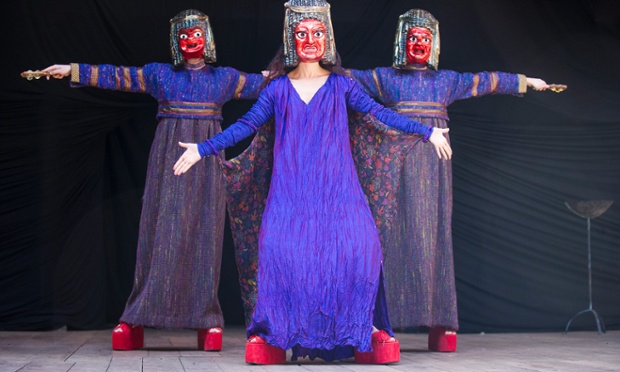
In addition to the displays of self-satisfaction and feminine sexuality, director Lucy Bailey also seemed to emphasize another aspect of Tamora’s character. Despite praising her own “high-wit,” many of Tamora’s decisions seem to be made hastily and as a result of emotion rather than her cunning and logical planning. For example, the order she gave to the nurse to kill her child seems to have been a desperate and emotional decision. Although Tamora herself is not seen on-stage, the nurse’s own panic suggests that Tamora was in a similar state of distress. The utter fear of having her affair discovered (and thereby putting herself in danger) caused her to make a rash decision without actually conferring with Aaron himself about the matter. Tamora’s planning seems to be equally flimsy towards the end of the play when she decides to haunt Titus as the spirit of Revenge, along with her sons dressed as Rape and Murder. In the text, Tamora declares that she has no plan to take advantage of Lucius being invited to a dinner, by saying that she will simply “find some cunning practice out of hand.” The comedic portrayal of the haunting scene and the lack of composure by Tamora and her sons during it highlight the ridiculousness of the plan itself. Such a decision would seem out of character for someone who is a ruthless and cunning manipulator our for revenge, but the scene feels more in-line with the rest of the play’s characterization of Tamora as an almost arrogant and comedic woman.
Despite my initial perceptions and desires for the character of Tamora, Indira Varma’s version of the character still had her own unique charm. Her confidence and wicked delight in the pursuit of vengeance gave her an appeal similar to that of a Disney villainess. Ultimately, downplaying Tamora’s character had not effect on the overall reception of the Titus Andronicus itself. The performance managed to be just as full of violence, bloodshed, and revenge as any theater-goer would expect.