

Trevor White’s excellent Hotspur
Did you know that I Henry IV is currently on back at Blackfriars in Staunton? I feel robbed of Rick Blunt’s Falstaff, but then again, according to some of the reviews, I probably wouldn’t like the character any better than I do now. What is more intriguing from those reviews, however, is the tales of Patrick Midgley’s Hotspur. It seems the ASC goes for a sympathetic portrayal of the character, which stands in direct contrast to the RSC’s version, as played by Trevor White. This Hotspur displays what the director Gregory Doran calls “an almost capricious childlike desire for, ambition.” While this makes for compelling theater, it also strays too far from the text at times, which renders the motives of other characters incomprehensible.
Trevor White bleached his hair Draco-Malfoy-blond for the production, and it gleams under the blue-tinged stage lights. The intensity of his appearance is mirrored in a physically exhausting performance. (After Hotspur’s death, White can be seen taking what are well deserved deep breaths after the strenuous fight scenes.) The manic energy that the character displays pulses, what with the way his muscles strain and twitch. Even when White is standing still, he bounces with energy and fills the stage with a larger than life persona. The performance develops Hotspur as a fascinating character, but there is a deeply disturbing undercurrent as well.
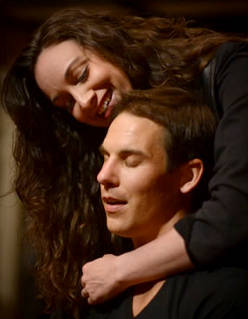
The ASC’s Percys
In this, the production cuts the play’s sympathy for Hotspur in half. In the text, one of the most redeeming features about the character is his love for his wife. When Lady Percy has been hurt by Hotspur’s words and asks him if he loves her, Harry answers:
Come, wilt thou see me ride?
And when I am on horseback, I will swear
I love thee infinitely. But hark you, Kate;
I must not have you henceforth question me
Whither I go, nor reason whereabout.
Granted, Hotspur already comes across as callous in the lines because he skirts the question even as he answers it and so undermines the emotion. But the line could be interpreted sympathetically, as a reluctant but awkward move to incorporate Kate into his life. Doran does not give Hotspur this line at all, however. Rather, White says, “Come, wilt thou see me ride? But hark you, Kate…” By taking away the future promise, the production separates Hotspur from positive emotions. While it is clear to the audience that Hotspur loves his wife as much as he is able to, he still cannot express his emotions or even offer her a token of comfort in his impatience. Because White and Jennifer Kirby (the play’s Lady Percy) start this speech at opposing corners of the stage, White must cross to her. He comes not with words of comfort but rather with a highly physical reprimand. They isolate themselves from each other even when in each other’s embrace. Ultimately, even with the violence that Kirby returns to him, White’s Hotspur is abusive.

The RSC’s Percys
Herein lies the central problem of the character’s portrayal. For all of the excellent acting that White displays, Doran is stripping away the integrity of the other characters. It is hard to believe that a character as strong as Lady Percy could love this man. The passion in their marriage seems to come more from hatred than the sexual tension other productions favor.
The rest of Hotspur’s family also changes, particularly Antony Byrne’s Worcester. Both Worcester and Northumberland physically punish Hotspur to bring him in line when they plant the seeds of rebellion. Worcester takes this further by deciding to risk Hotspur’s life to save his own. Worcester is truly “Malevolent to [Henry IV] in all aspects”, and, if he actually loves his nephew, he hides it well. Therefore, when the King offers his terms of reconciliation, Worcester manipulates Hotspur into rejecting them. His justification is:
And an adopted name of privilege,
A hair-brain’d Hotspur, govern’d by a spleen:
All his offences live upon my head
And on his father’s; we did train him on,
And, his corruption being ta’en from us,
We, as the spring of all, shall pay for all.
Worcester then tells Hotspur that the king refused their grievances. This is a subtle change in characterization. Worcester acts as if he were Hotspur’s handler than his uncle. The stage performance preserves this relationship. Yet in the original interpretation, these lines and this scene show that Worcester knows his nephew’s mind and actions well. With the extreme Hotspur, Worcester completely misses the point and becomes even more heartless than he already was. To the audience, it is clear that Hotspur is itching for a fight, and in his pride he would still march to battle, even under the mild terms he was offered. Worcester’s actions are unnecessary. He is not a likeable character under normal circumstances. Under this interpretation, though, he is a character to loathe.
In retrospect, even Henry IV’s loses internal consistency to the new Hotspur. In his first scene, he praises Henry Percy:
O that it could be proved
That some night-tripping fairy had exchanged
In cradle-clothes our children where they lay,
And call’d mine Percy, his Plantagenet!
In wishing that Hotspur were his son, Henry IV reveals much about his relationship with his son, but also about what he values in a son. Right before those lines, he calls Hotspur “sweet Fortune’s minion and her pride.” Jasper Britton plays these lines with all of the fervent anguish that he brings to the part. But in light of the actual performed Hotspur, it is hard to believe that anyone would want him as a son. His own father finds Hotspur tolerable at best, but they treat him as a bulldog than a human being. In contrast, when Henry IV and Hal finally meet on stage, their relationship seems ten times healthier. I don’t think Duran intended Henry IV to come across as this delusional and ignorant of reality. However, with all of characters portrayed to their maximum angst potential, some characters are going to become less convincing.
One character does not suffer this derailment, though. Hal’s exaggeration of Hotspur’s bloodlust is more justified with such an unpredictable man-child. Hal recognizes the danger in holding Hotspur as a rival or role model, saying:
I am not yet of Percy’s mind, the
Hotspur of the north; he that kills me some six or
seven dozen of Scots at a breakfast, washes his
hands, and says to his wife ‘Fie upon this quiet
life! I want work.’
While “childish ambition” is closer to the truth than Hal’s over-the-top description, his words still foreshadow the Hotspur that will be seconds away from taking on the entire king’s army by himself in the final scenes of the play. It is only right that Hal, when seeing an image of Hotspur during a brilliant scene transition, is spooked and needs a drink to clear his head. The combination of Hotspur’s skills and his recklessness should make him a formidable opponent. By winning the fight with this version of Hotspur, Hal truly shows that he has grown up.