
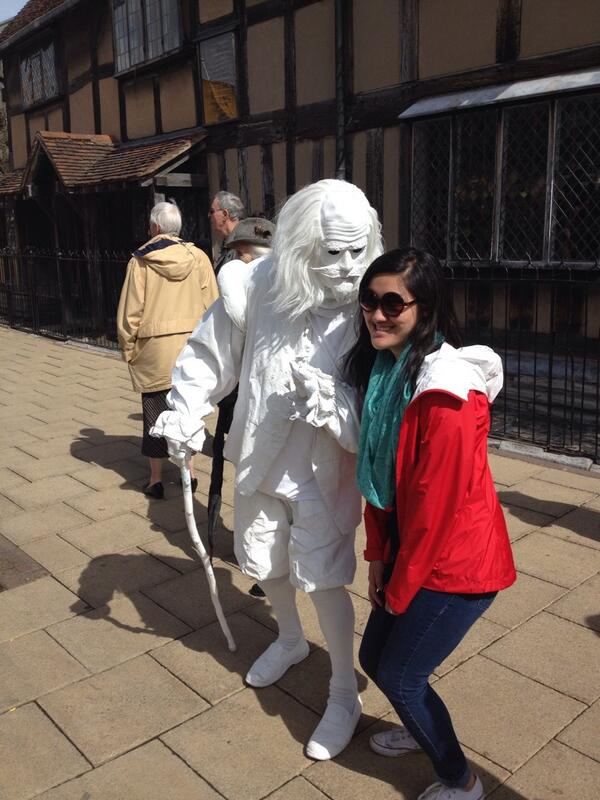
The Shade of Shakespeare with Yejean.
We ran into Shakespeare’s ghost today. While exploring the town-wide celebrations of Shakespeare’s 450th birthday, we saw the Bard, chalk-white from head to toe, float by. We got some photographic evidence of the encounter and then he drifted off. But the encounter got me thinking about Bill Shakespeare’s exceptionally long afterlife, and the long shadow that he has cast over not only literary history but wider Western culture.
After all, it’s been 450 years since the man was born, and his plays are staged thousands of time each year and taught in almost every school worth its salt in the English-speaking world. I can’t think of any other individual in history whose 450th birthday received as many fireworks, parades, and blog posts from college students as has Shakespeare’s.
So how have the plays survived and continued to be relevant long after the world in which they are set has passed away? I initially pondered if the plays’ archetypical characters and stories were at the heart of their lasting appeal. But that doesn’t quite explain it. Of course, that’s not to say that the archetypical nature of some of the stories and characters doesn’t help: even if a modern audience doesn’t know the historical biography of King Henry V, they can understand that Falstaff’s pal is an irresponsible youth and connect with him as such, and though I know little about the hostilities between the Romans and the Goths, I can understand the archetypical “revenge plot” that drives Titus Andronicus.
But nonetheless, Shakespeare’s characters are far too complex and exhibit too many contradictions to be reduced simply to clichés. So that can’t be the answer. Then I thought of something W&L’s own Professor Gavaler told our fiction-writing class. He warned us not to be afraid to write about seemingly esoteric or unique experiences that we feared readers wouldn’t connect with. He told us that the best way to connect with a wider audience was to create characters and situations in as specific detail as possible. In his view, even if the audience hadn’t encountered such things in their own lives, they would understand the emotional reality we as authors were aiming for, whereas if we wrote in clichés and tropes in hopes of connecting with audiences’ pre-existing experiences, we would simply bore them.
I’ve done a terrible job of summing up Gavaler’s philosophy, but the basic idea is that to appeal to a mass audience, an author must make his work specific rather than broad. For me, this model goes a great way to explaining Shakespeare’s enduring popularity. Though many of his tales have archetypical overtones (the young lover’s, the power-hungry tyrant), they are far from stale repetitions of earlier stories. Instead, their endurance seems to come from the elements of the plays that defy conventions. Macbeth initially seems to be just another scheming usurper, but the Thane of Cawdor is truly compelling because unlike the thousands of other similar characters, he remains acutely conscious of the horrific nature of his actions. We appreciate Hamlet not because he fills the mold of the avenging son, but because he is a whiny and useless child through whom Shakespeare makes a mockery of that character type.
So perhaps Shakespeare is still remembered because he found a third way. His plays do tap into broad archetypes and the primal stories that humans all across the globe can relate to and understand, yet his subversions of the tropes of these story types are what truly set him apart from the millions of other artists through history who won’t get fireworks and parades on their 450th birthday.