
Ever since the question was posed in our first introduction to the course, I have found myself wondering how location can affect my interpretation of Shakespeare. How does being in his birthplace and eventually his workplace enhance my engagement with the texts? While I do not think that I have answered these questions yet, I do feel marginally closer.
I think one of the most incredible things about Shakespeare is how his works endure through time, space, and cultures. They have been translated, transposed, re-appropriated, and interpreted in so many different ways but they are still, fundamentally, Shakespeare’s reflections. Knowing that, I wondered how going to England was going to affect me. If Shakespeare can be interpreted from anywhere and any perspective, then why and how would this trip make a difference in my understanding of his work? What I have concluded thus far is that time and location can simultaneously mean nothing and everything. While location does not seem of importance in the sense that anyone in any location can study Shakespeare and find something valuable, where and when someone interprets his writings skew how those words are received and how they are presented to others.
As Nick Walton shared with us on the second day here,
“[Shakespeare’s plays] don’t have absolute meanings. There is no fixed, frozen way of doing them. Nobody can mine a Shakespeare play and discover a ‘solution,’ and to pretend that style, fashion, and taste are fixed is to ignore history.” (Richard Eyre, Changing Stages, 2000).
Thus, where someone is in time and space matters in how they read Shakespeare. For me, reading and seeing his works on stage in England thus far has served to prove this concept further. Seeing all of these people from so many different areas of the world gathering in a tiny English town just to celebrate this man’s birthday, a man who has not been alive for 398 years, was unbelievable. Hearing from actors and scholars from different background and with different interests and specialties in Shakespeare and in theater in general has been equally amazing. They are all so passionate about this poet, and infinitely various in the reasons why they are inspired by his work.
One might think that I could recognize this seemingly simple idea from anywhere in the world and that I would not need to cross the Atlantic to understand it. Well, call me dense, but I did need to cross an ocean to fully grasp how incredible and far-reaching his creations are. I think part of this is because exposing myself to a new culture, the British culture, has been so jarring that to think how different my current habits and customs must be from those in Shakespeare’s time, it becomes even more tremendous that he could write anything so enduring. His pieces so often work at studies of human character and relationships, lending them realism and allowing people from around the world to connect with them.
“Age cannot wither her, nor custom stale / Her infinite variety.” – Antony and Cleopatra, ActII Scene II
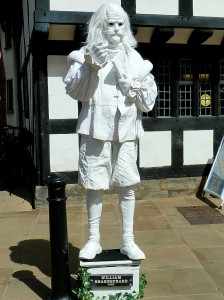
A ghost of Shakespeare haunting Stratford-upon-Avon on his birthday celebration.